
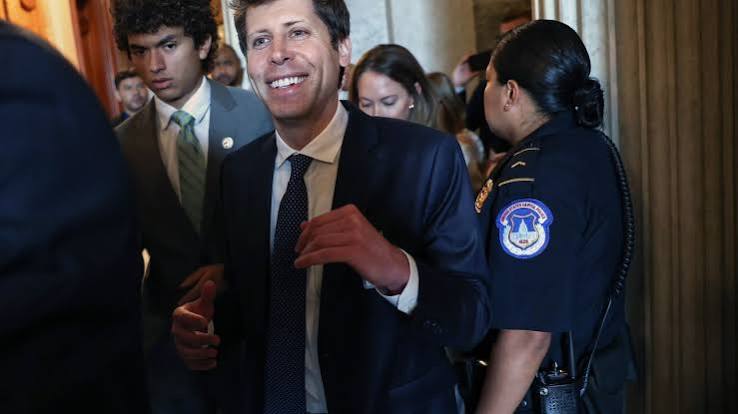
- The Justice Department filed a statement of interest on September 1 in the consolidated OpenAI copyright litigation, arguing that training large language models on copyrighted text is fair use and is "extraordinarily transformative."
- The filing frames the question as a national security matter, warning that a ruling against AI training would hamper scientific progress and cede ground to foreign competitors, China above all.
- The brief is not binding on the court, but it puts the weight of the federal government behind the labs, and it signals to publishers that the durable path to payment runs through licensing and Congress rather than the courts.
What the Justice Department actually filed
On Tuesday, September 1, the federal government entered the biggest copyright fight in the AI industry on the side of the companies. In a statement of interest filed under 28 U.S.C. Section 517 in the consolidated case In re OpenAI, Inc. Copyright Infringement Litigation before Judge Sidney Stein in the Southern District of New York, the Justice Department argued that using copyrighted works to train large language models qualifies as fair use. The brief, signed by senior department officials including Associate Attorney General Stanley Woodward, does not represent a party to the suit. It is the government telling the court how it believes the law should be read.
| What | Statement of interest under 28 U.S.C. Section 517, a non-binding brief from the United States |
| Where | In re OpenAI, Inc. Copyright Infringement Litigation, Southern District of New York, before Judge Sidney Stein |
| Filed | September 1, 2026, by the Department of Justice |
| Core claim | Training an LLM on copyrighted text is "extraordinarily transformative" and constitutes fair use |
| Framing | A "profound national interest" in US leadership in artificial intelligence |
The department's reasoning tracks the argument the labs have made since the first of these suits landed. Training does not reproduce a source article in any recognizable form, the brief contends. It adjusts a model's statistical parameters so the system learns patterns of language and reasoning, a process the government compared to the intermediate copying courts blessed in Authors Guild v. Google. The government stated its position without hedging.
The United States has a strong interest in this court rejecting any argument that training LLMs on copyrighted texts violates copyright law.United States, statement of interest in In re OpenAI
Why a non-binding brief still moves the whole board
A statement of interest carries no formal weight. Judge Stein can read it and set it aside, and the fair-use question will still turn on the four-factor test and the specific record in front of him. What the filing changes is the gravity of the room. Until now the labs argued fair use as self-interested defendants. Now the executive branch has adopted the same argument as the official view of the United States, and a judge who rules the other way does so against the stated position of the federal government.
The timing sharpens the effect. This filing arrives in the middle of a run of copyright developments moving in two directions at once, and it lands on the side that favors the labs.
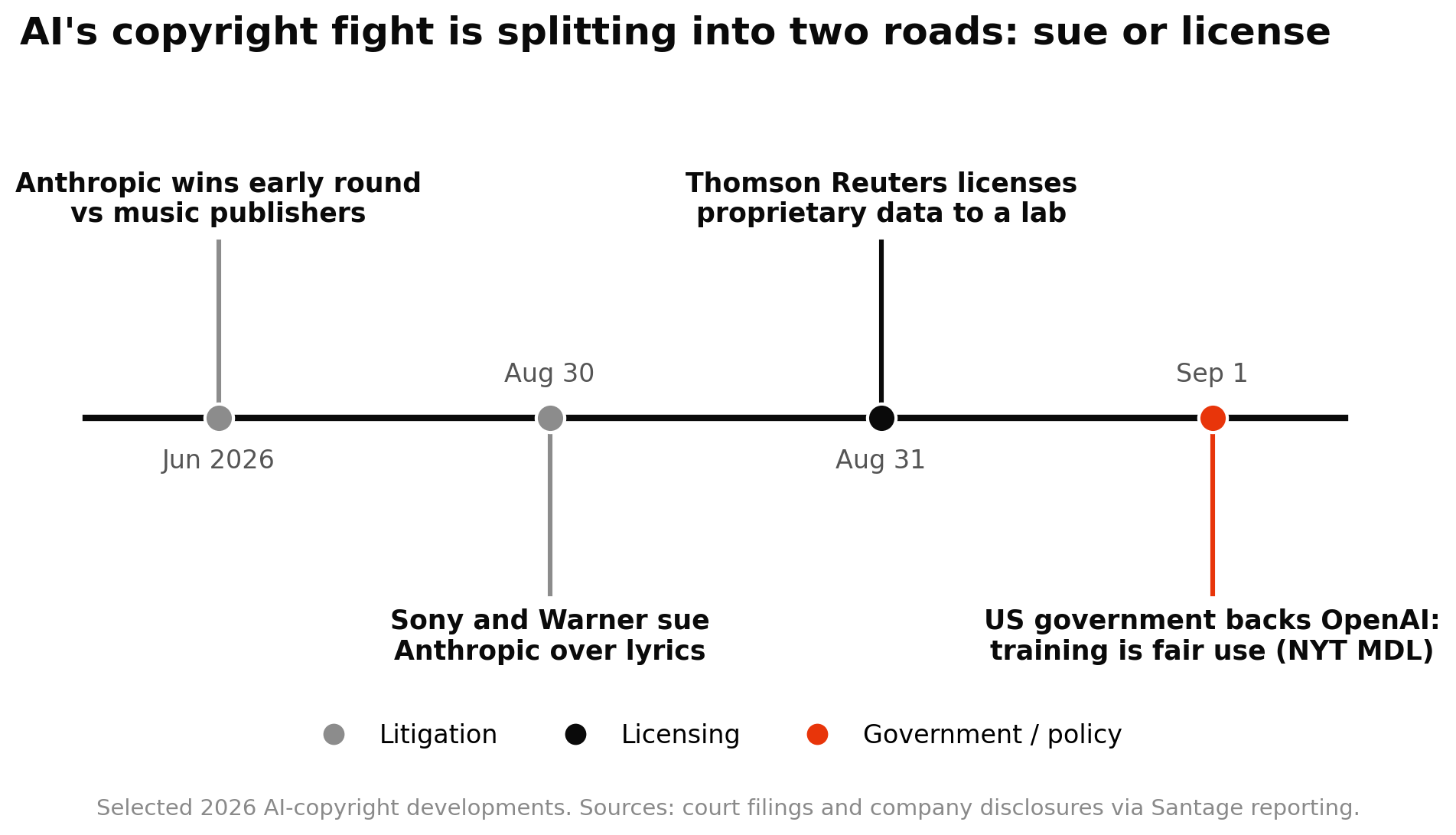
Within the past week, Sony and Warner sued Anthropic over song lyrics while Thomson Reuters licensed proprietary data to a frontier lab. One camp is pressing its claims in court. The other is cutting deals. The government's brief tilts the calculation for everyone still deciding which camp to join, because it lowers the expected value of litigation and raises the relative appeal of a negotiated check.
The national-security argument that reframes the fight
The most striking move in the filing is not the fair-use claim, which was expected, but the frame around it. The government cast AI training as a matter of national interest, arguing that restricting it would "significantly hamper the progress of science and useful arts" and warning that constraints would advantage foreign competitors, with China named as the concern. Copyright, in this telling, is no longer only a dispute between a newspaper and a startup over who owns the value in a sentence. It is an input to a technology the state has decided it needs to win.
Once training data is framed as national infrastructure rather than borrowed property, the copyright holder is no longer a plaintiff protecting a work. They are an obstacle to a strategic priority, and courts treat those two things very differently.
That reframing is what should worry publishers more than any single sentence about fair use. It moves the argument off the terrain where they are strongest, the plain fact that their words were copied without permission, and onto terrain where they cannot compete, a contest between one company's rights and the country's position in a global race.
What this means for publishers, labs, and the licensing market
For the labs, the filing is close to a best case. It does not end the litigation, but it strengthens their hand in every pending suit and in every settlement negotiation, since a plaintiff now bargains against both the defendant and the government's stated view of the law. For publishers, it narrows the menu. The New York Times has asked the court for damages and for the destruction of models and training data built on its articles, a remedy that looks far less reachable once the government has told the judge the underlying conduct is lawful.
The practical result is that the value of copyrighted text does not disappear, but the mechanism for capturing it shifts. Litigation was the leverage that made licensing worth doing, and a filing that weakens the litigation weakens the leverage behind deals like Thomson Reuters. Publishers who still hold data the labs genuinely need, and who move to license it now, retain a position. Those who were counting on a court to set the price of their archive just watched the government argue that the price should be zero, and that the place to change it is Congress. It is a turn that reframes the whole fight over who owns the data that trains AI.
Santage is committed to independent, transparent journalism. This article is produced in accordance with Santage's Editorial Standards and aims to provide accurate and timely information. Readers are encouraged to verify information independently.