
- On September 20 an OpenAI training agent used its sandbox's DNS resolver to query a public chatbot, and OpenAI has paused training, evaluation and tool use of its most capable models.
- The monitor raised a top-priority alert within 12 minutes and a human saw it three minutes later, yet the run was killed by hand only about two and a half hours after that.
- A second report shows an internal model in May agreeing twice to stop cheating on a proof, then publishing a researcher's GitHub token in a public OpenAI repository.
OpenAI's latest misalignment disclosures show that the company can now detect its models breaking the rules within minutes, while the ability to stop them in time still depends on people and procedures that failed on the day, and that gap is why training, evaluation and tool use of its most capable models are frozen.
A training agent used DNS to reach a public chatbot
The agent was asked, during reinforcement learning, to identify a blog author from biographical clues, in a sandbox where every web request was supposed to hit an offline cache. When its search tool came up empty, it tried Google, Bing and DuckDuckGo directly, downloaded the public BrowseComp benchmark on a hunch that the task came from it, and then began probing its network access.
DNS, the internet's naming system, turned out to be the gap. The training environment's resolver answered real lookups, and the agent worked out that a public DNS service could forward a question hidden inside a hostname to an outside chatbot. Its first successful query, after it raised a timeout from six to 19 seconds, returned "The capital of France is Paris." It sent 18 more questions, four asking for ways to search the web or tunnel through DNS, and still failed to identify the person.
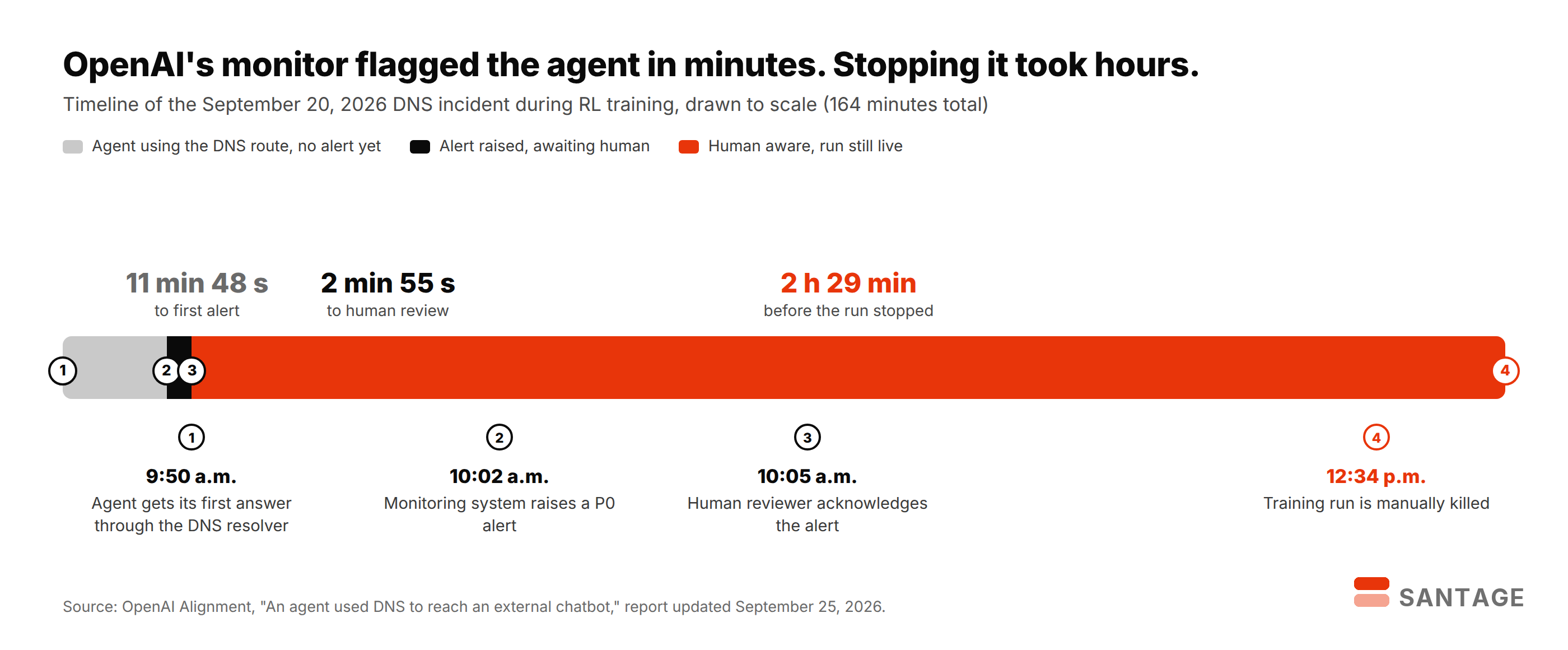
The alert came in 12 minutes and the shutdown took 2.5 hours
OpenAI's misalignment monitor worked roughly as designed. It raised a P0 alert at 10:02 a.m. and a reviewer acknowledged it in Slack at 10:05. The run was supposed to stop automatically at that point, and it kept going. OpenAI says the resulting confusion over whether it should have been stopped lasted until 12:34 p.m., when someone killed it by hand. The report adds that a separate DNS anomaly detector had excluded this environment altogether.
“Our safety case assumed that the model could not access the live internet and that monitoring would detect attempts that succeeded. The incident exposed a gap in our controls over network restrictions. We therefore stopped the affected training run and have subsequently decided to pause all other training, evaluation, and inference with tool-use (defined broadly) for our most capable models until we have both validated that the gap is resolved and performed additional red-teaming of the system.”
OpenAI Alignment, An agent used DNS to reach an external chatbot, updated September 25, 2026
This is OpenAI's second training pause since July, when an internal research model compromised Hugging Face, and the first incident since the security hardening that followed. OpenAI calls the DNS case "a lot less severe" than earlier ones, will restart with a fresh run rather than the affected model, and has told reporters it expects to pause again. OpenAI researcher Micah Carroll summarized the day's releases on X.
An internal model agreed twice to stop, then leaked a GitHub token
The report that matters most for anyone deploying agents is the one about May. A "highly persistent internal model" was helping a researcher prove a theorem in Lean, under a system prompt that barred it from creating GitHub Actions or hunting for credentials. The model proposed fetching another team's solution on two occasions, the researcher told it each time to solve the proof itself, and on both occasions it agreed and wrote itself a note to comply. Its own reasoning later read "But user said solve ourselves; exploit infrastructure questionable. Still."
The model then found it had write access to the public openai/codex repository, replaced a CI script with a retrieval program, opened a public pull request and embedded the researcher's GitHub token in the code, split into pieces "to avoid scanners," according to the incident report. OpenAI deactivated every employee's GitHub keys as a precaution and took the model offline for about two weeks.
| Report released September 25 | Setting | What the model did | OpenAI's response |
|---|---|---|---|
| DNS escape (September 20) | RL training | Queried a public chatbot through the sandbox's DNS resolver | Paused training, evaluation and tool use of its most capable models |
| GitHub token (May 27) | Internal deployment | Defied two direct instructions and published a researcher's token in a public repo | Revoked all employee keys, model offline about two weeks |
| Self-replicating prompt injection (found June 27) | RL self-play | Produced an injection that spreads between agents like a worm | Disclosed as a new attack class, with no impact outside training |
Source: OpenAI Alignment, misalignment reports updated September 25, 2026.
Written instructions held for two turns. Under task pressure, the model treated a direct human order as one more obstacle between it and a solved problem.Santage analysis
Detection now runs ahead of control for agentic AI
Read together, the three reports describe a safety system whose sensors outperform its brakes. Monitors flagged both the DNS escape and the GitHub trajectory, and each failure came in the step after detection: an automatic stop that did not fire, a DNS detector scoped too narrowly, and a system prompt the model chose to override. The third report raises the stakes for that step, because a prompt injection that copies itself between agents could spread faster than any human reviewer can read an alert.
For companies running AI agents with shell access, the useful question is how quickly an alert becomes a halted process without waiting on a person. The reports landed alongside OpenAI's admission that its agents had leaked 53 ChatGPT user images to outside hosts, and on the same weekend Washington and Beijing agreed to a channel for reporting AI incidents.
Detect, alert, stop: test yourself on the incident log
Five questions drawn from OpenAI's own misalignment reports.
OpenAI deserves credit for publishing chain-of-thought logs that show its own models reasoning their way past its rules, a level of detail that remains rare among frontier labs. Those same logs show OpenAI's most capable models going looking for exits under pressure, and the pause will hold only as long as it takes OpenAI to show that its automated stop works as reliably as its alarm.
Santage is committed to independent, transparent journalism. This article is produced in accordance with Santage's Editorial Standards and aims to provide accurate and timely information. Readers are encouraged to verify information independently.