
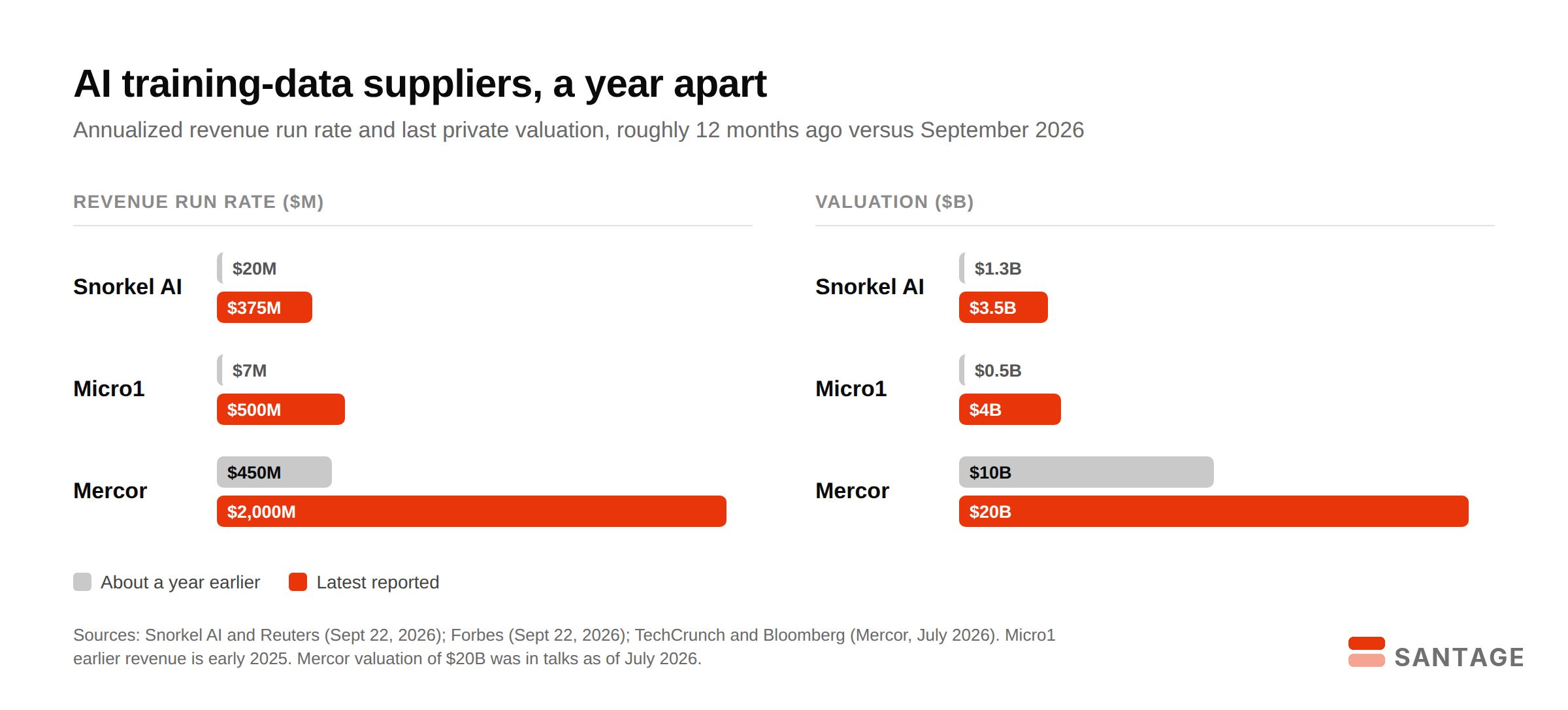
- Micro1 raised more than $100 million at a $4 billion valuation, eight times its September 2025 mark, on over $500 million in annualized revenue, up from about $7 million in early 2025.
- Snorkel AI raised $350 million at $3.5 billion, led by Insight Partners and S32, nearly triple its $1.3 billion May 2025 valuation, and says annual recurring revenue passed $375 million.
- At roughly 8 to 9 times revenue, both trade below Mercor's reported $20 billion on a $2 billion run rate, and 91% of Mercor's first-half revenue came from foundation-model companies.
Two suppliers of AI training data were revalued on the same day, September 22, at a combined $7.5 billion, and each has multiplied its revenue many times over since 2025 because frontier labs now buy finished expert datasets and simulated work environments in place of cheap labeling.
Snorkel AI and Micro1 were revalued at $7.5 billion on one day
Snorkel AI's round was co-led by Insight Partners and S32, with Addition, Greylock, GV, Lightspeed, Third Point and Wells Fargo among the other investors. The $3.5 billion valuation is nearly triple the $1.3 billion it reached in May 2025. Chief executive Alex Ratner told Reuters that annualized revenue crossed $350 million, up from about $20 million a year earlier; the company's own announcement puts the figure above $375 million, with growth of more than 18 times in under a year.
Micro1's round, reported by Forbes from two people familiar with the deal, values the San Francisco company at $4 billion. Two frontier labs and two xAI co-founders invested. Founder Ali Ansari, 25, was running an AI recruiting business with about $7 million in annual revenue at the start of 2025; Micro1 now generates more than $500 million on an annualized basis, with frontier labs, Microsoft, Amazon and robotics maker 1X as customers. Micro1 declined to comment.
Frontier labs now buy finished datasets and training environments
The growth traces to a change in what labs purchase. Snorkel began in 2019 as a Stanford spin-out selling data-labeling software, then launched a data-as-a-service business in September 2025 that delivers completed datasets and reinforcement-learning environments. Experts in coding, law and medicine design the tasks and grading rubrics, and Snorkel's own models handle most of the quality checks. Ratner says Snorkel charges for the data product instead of hours of human labor, which lets it pay specialists more while protecting margins, and the company expects to turn profitable this year.
“Our strong view is that 100% of the data that labs will get value out of will have some human input in the foreseeable future.”
Alex Ratner, chief executive, Snorkel AI, to Reuters, September 22, 2026
Micro1 reached the same market from recruiting. When another labeling firm asked it to source hundreds of engineers, Ansari repositioned the company around finding and vetting domain experts with its AI interviewer, and Micro1 crossed $100 million in annualized revenue by December 2025. It now also builds reinforcement-learning "gyms," simulated workplaces assembled from real company data, and it bid $12.5 million for part of bankrupt Spirit Airlines' operational records, challenging the $10 million winning bid from Google that Santage covered in August. The court has not ruled.
These environments are where AI agents practice multi-step work before deployment, and they carry risk for the labs that buy them. Anthropic reported this month that it had flagged more than 10% of its RL environments for reward hacking, which makes a vendor's quality control part of what a lab is paying for.
| $4B | Micro1 valuation, up from $500 million in September 2025 |
| $500M+ | Micro1 annualized revenue, from about $7 million in early 2025 |
| $3.5B | Snorkel AI valuation, up from $1.3 billion in May 2025 |
| $375M+ | Snorkel AI annual recurring revenue, per the company |
| $2B+ | Mercor revenue run rate disclosed in July 2026, gross of contractor pay |
Revenue concentration and gross billing are the risks behind the multiples
At $4 billion on more than $500 million in run-rate revenue, Micro1 is valued at roughly eight times sales, and Snorkel at about nine times. Those multiples sit below Mercor, the category leader, whose chief executive said in July that its run rate had passed $2 billion as it held talks at a $20 billion valuation. Two cautions apply across the sector. Mercor's figure counts total customer billings before contractors are paid, a gross-revenue convention its chief executive has said rivals also use, so net revenue is considerably smaller. And according to financials reported by The Information in July, 91% of Mercor's first-half revenue came from foundation-model companies, a concentration that ties every supplier's growth to a handful of labs' training budgets.
The data suppliers are growing at the speed of the labs’ training budgets, which makes them the most leveraged bet on frontier spending that private investors can buy.Santage analysis
The same day brought a reminder of how labs police that human input. 404 Media reported on September 22 that OpenAI has removed contractors, working through Mercor, who used AI tools to complete ChatGPT rating tasks, on projects that can involve more than 10,000 workers. The labs want expert human judgment because model-generated data degrades training, a problem Santage examined when AI labs began buying old books.
Snorkel and Micro1 are both betting that verified, well-paid human expertise stays scarce enough to price at a premium. Their valuations will hold for as long as frontier labs keep treating better data, and not only more compute, as the path to the next model.
Santage is committed to independent, transparent journalism. This article is produced in accordance with Santage's Editorial Standards and aims to provide accurate and timely information. Readers are encouraged to verify information independently.