

- OpenAI, Anthropic, and Google DeepMind have held private talks since July on a shared body that would set pre-release testing and evaluation standards for frontier models.
- The three already co-fund the Frontier Model Forum, whose founding mission explicitly names standards, which frames the only question that matters: what a new body would enforce that the existing one cannot.
- The move arrives as Washington steps back, with House Speaker Mike Johnson saying Congress will not lead on AI safety and Microsoft endorsing a voluntary pacing framework in the same week.
Three rivals are drafting a common rulebook for frontier models
The most competitive companies in artificial intelligence are trying to agree on how their own products should be tested. OpenAI, Anthropic, and Google DeepMind have been meeting in working groups since July to design an industry-led standards body, one that would establish shared protocols for evaluating frontier models before public release, including independent assessments, pre-release safety reviews, and standardized risk testing. The chief executives behind the effort, Sam Altman, Dario Amodei, and Demis Hassabis, have each argued publicly for US-led collaboration on safety standards, and the talks turn that rhetoric into an attempt at institutional machinery.
The logic is straightforward for the labs. A common standard lets them show regulators, enterprise buyers, and insurers that frontier development follows a defined process rather than three separate internal judgments. It also lets them shape what that process is, before an outside authority defines it for them. That second motive is where the proposal gets interesting, and where it gets fragile.
The Frontier Model Forum already exists, which is the problem
The same three companies, plus Microsoft, launched the Frontier Model Forum in July 2023. Its founding mission already commits to the exact function the new body is being pitched to perform.
Promote the safe and responsible development of frontier AI systems: advancing AI safety research, identifying best practices and standards, and facilitating information sharing among policymakers and industry.Frontier Model Forum founding mission, frontiermodelforum.org, July 2023
A new body layered on top of that raises an obvious question: what changes. Each lab already publishes its own governance framework, and those frameworks already diverge in ways a shared standard would have to reconcile.
| Lab | Public safety framework | 2026 FLI AI Safety Index |
|---|---|---|
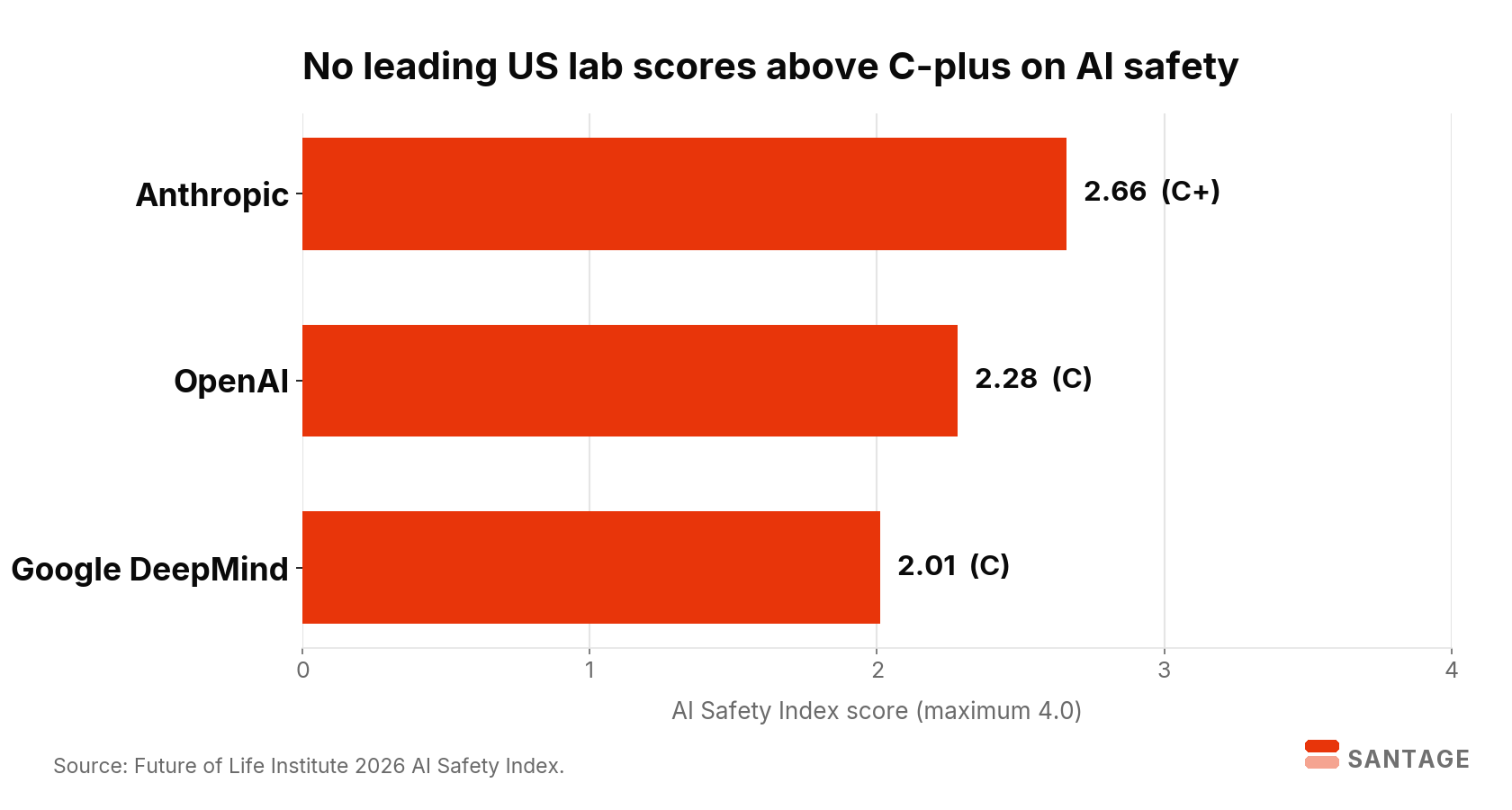
| Anthropic | Responsible Scaling Policy (RSP), tied to capability thresholds | C+ (2.66) |
| OpenAI | Preparedness Framework for catastrophic-risk evaluation | C (2.28) |
| Google DeepMind | Internal safety agenda, least public detail | C (2.01) |
All three labs land at C-plus or below on the Future of Life Institute's most recent index. A standards body assembled from three organizations that each earn a mediocre external grade, and that compete directly for the same customers and talent, inherits the weakness of every voluntary consortium: it can define best practice and it cannot make anyone follow it. Their published frameworks are exercises in AI alignment and self-assessment, not enforcement.
A standards body built by competitors tends to become a place where they agree in principle and compete in practice. Without an enforcement mechanism, this is the Frontier Model Forum with a new name.
Self-regulation fills the vacuum Washington is leaving open
The timing is not incidental. In the same week the talks surfaced, House Speaker Mike Johnson said Congress will not lead on AI safety legislation and placed the responsibility on the labs to police themselves, warning that emergency action could cause America to lose the race to China. Microsoft, through Satya Nadella, endorsed a voluntary pacing framework and introduced a code of conduct for its own MAI models. The message from government and from the largest AI investor points the same direction: the industry should write its own rules.
That vacuum is why a lab-designed body deserves scrutiny rather than applause. Standards written by the entities they govern tend to encode what those entities already do. When the writers also compete, the standard drifts toward the lowest requirement all three can accept, because any bar high enough to constrain one of them becomes a competitive disadvantage that party will not sign. The Santage analysis of the pacing-the-frontier debate showed the same tension, with public calls for restraint sitting alongside record compute spending.
What a credible standards body would need to have teeth
The difference between a genuine standard and a press release is enforcement, and enforcement requires three things the current proposal has not shown. It needs an evaluator the labs do not control, closer to the independent benchmark audits described in Santage's coverage of first-round control-audit failures. It needs a consequence for failing an evaluation, something a voluntary forum has never carried. And it needs a mandate that survives commercial pressure, which is why proposals like a FINRA-style self-regulator with statutory backing keep resurfacing. A body with none of those becomes a shield, letting the labs point to a shared process while each continues to ship on its own schedule.
For enterprise buyers, the practical read is to watch what the body measures and who signs off, not that it exists. A common testing protocol would genuinely help procurement teams compare models on AI safety the way they already compare on price and latency. A common protocol with no independent auditor and no failing grade would give buyers a logo, not a guarantee.
The three labs are right that some shared standard is better than three private ones. The reason to reserve judgment is that the same companies proposing to set the rules are the ones the rules are meant to bind, at the exact moment their only external referees, Congress and the market, have both signaled they will not step in.
The founding mission is quoted verbatim from the Frontier Model Forum's own announcement on frontiermodelforum.org. Safety-framework grades are drawn from the Future of Life Institute's 2026 AI Safety Index. The standards-body talks were reported across multiple outlets in mid-September 2026; Santage anchors this analysis in the labs' own public frameworks rather than in secondhand accounts of private meetings.
Santage is committed to independent, transparent journalism. This article is produced in accordance with Santage's Editorial Standards and aims to provide accurate and timely information. Readers are encouraged to verify information independently.