
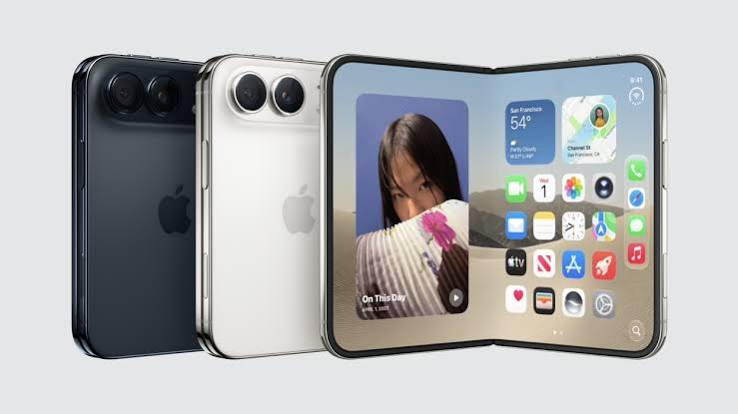
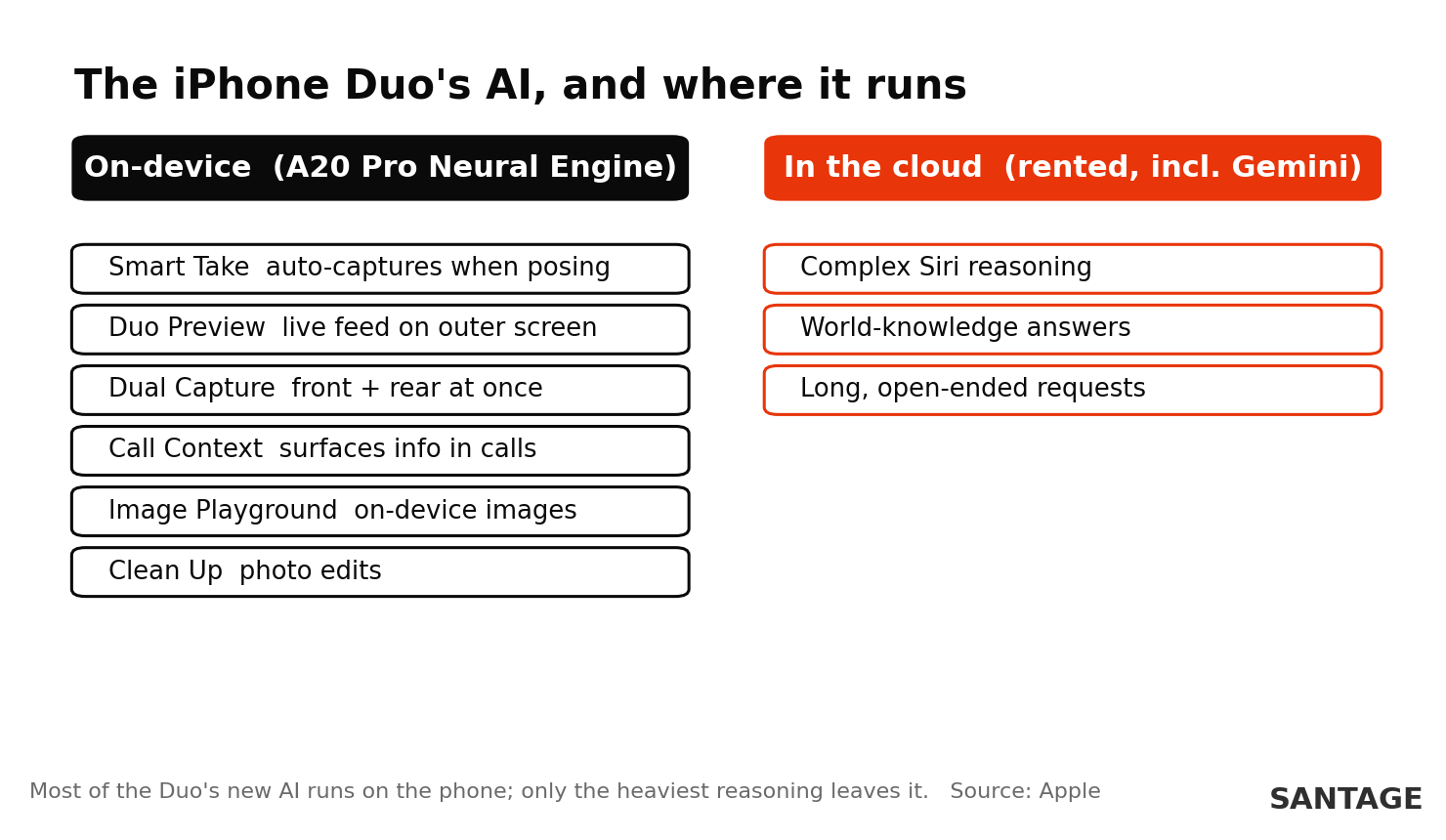
- The Duo's marquee AI is on-device and form-factor-native: Smart Take, Duo Preview, Dual Capture, and Call Context all run on the A20 Pro's dual 16-core Neural Engine, which Apple says doubles on-device AI compute.
- The features are incremental quality-of-life wins, not a reasoning breakthrough, and only the heaviest Siri requests still leave the phone, where Google's Gemini handles them.
- At $1,999 the AI is not what you are paying for. The foldable hardware is, and the AI's job is to make two screens and a $1,999 price feel justified.
What Apple shipped, and where the intelligence lives
The hardware is the headline Apple wanted. The Duo is the first iPhone with two screens and a flexible display, a 7.6-inch inner panel and a 5.4-inch cover screen, both at 3000 nits, on the 2-nanometer A20 Pro. CEO John Ternus, in his first launch since taking over, called it "the most transformational change to iPhone since the original." Pre-orders open October 16 and it ships October 23.
Apple's official introduction film for the iPhone Duo, its first foldable. Source: Apple, via YouTube
The AI story sits underneath that, and it is deliberately quiet. The A20 Pro carries a dual 16-core Neural Engine built to run on-device models, and the features Apple showcased lean on the fold rather than on a chatbot. Smart Take watches a scene and fires the shutter when people are posing. Duo Preview turns the cover screen into a live viewfinder so the subject can frame themselves. Dual Capture shoots front and rear together. Call Context surfaces relevant details mid-call. Siri gains onscreen awareness and a write-by-describing mode, and complex questions still route out to a 1.2-trillion-parameter Gemini model that Apple licenses from Google, an arrangement first reported by Bloomberg. Apple's own on-device model, by contrast, sits at roughly 3 billion parameters.
| $1,999 | starting price for the 256GB Duo, with capacities up to 2TB. |
| Dual 16-core | the A20 Pro Neural Engine Apple says doubles on-device AI compute. |
| 7.6 in / 5.4 in | the inner and outer displays that most of the new AI features are built around. |
| Oct 23 | ship date, with pre-orders opening October 16. |
Are the AI features worth it, and what they imply
On their own, none of these features would sell a phone. Smart Take and Duo Preview are conveniences, Clean Up and Image Playground exist on cheaper iPhones, and the genuinely new behaviors depend on owning a $1,999 folding screen. Judged as artificial intelligence, this is not a jump past Gemini or ChatGPT, and Apple did not pretend it was. Judged as product design, it is coherent: the AI earns the Neural Engine and makes the second screen feel like it has a reason to exist beyond novelty.
Apple is not trying to win the model race on this phone. It is trying to make AI disappear into hardware moments, and to keep those moments running on silicon it controls rather than a model it rents.
That is the implication worth sitting with. While rivals sell the assistant, Apple is selling AI as an ambient property of the device, most of it local, private, and tied to a form factor only Apple ships. It is a defensible lane, because on-device features cannot be cloned by a better cloud model, and it plays to Apple's silicon and integration moat. It is also a hedge that admits the ceiling: the smartest thing the Duo can do still leaves the phone and lands on Google's servers. Apple has decided that for now, owning the everyday AI and renting the hard part is the bet, and the $1,999 foldable is where it is asking customers to pay for it. It is the same dependence Apple has been trying to escape elsewhere, from its split-stack Qwen deal in China to the Gemini-Siri partnership it first signaled at WWDC, and it arrives while Apple is still suing OpenAI over trade secrets tied to the same race. For a company that owns its chips, its models at the edge, and its stores, the intelligence in its flagship AI feature is the one part it had to rent.
Santage is committed to independent, transparent journalism. This article is produced in accordance with Santage's Editorial Standards and aims to provide accurate and timely information. Readers are encouraged to verify information independently.