
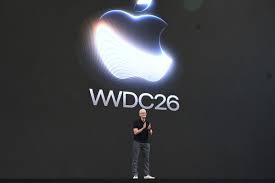
- Apple unveiled Siri AI at WWDC 2026, powered by a custom version of Google's Gemini model at an estimated $1 billion per year, confirmed at the June 8 keynote.
- Simple queries run on-device via Apple Silicon; complex reasoning routes to Google's cloud through Private Cloud Compute, with ChatGPT remaining available as an opt-in alternative.
- Siri AI will not be available in the EU or China at launch due to unresolved regulatory requirements in both markets.
Apple's new Siri routes complex queries to a 1.2 trillion-parameter Gemini model
Apple unveiled Siri AI at its WWDC 2026 keynote on June 8, confirming what had been the subject of months of speculation: the new conversational assistant runs on a custom version of Google's Gemini model. According to Apple's newsroom, the architecture splits tasks between on-device and cloud inference. Reporting from Bloomberg estimates the deal at roughly $1 billion per year for access to a Gemini model reported at approximately 1.2 trillion parameters.
On-device tasks, including voice recognition, expressive speech synthesis, on-screen awareness, and personal context lookups, run entirely on Apple Silicon using Apple's own next-generation foundation models. Only heavier queries requiring broad world knowledge or complex multi-step reasoning are routed to the cloud via Private Cloud Compute, where the Gemini model handles the response. Users who opted into ChatGPT for specific queries under the 2024 arrangement can continue to do so. Gemini is now the default backbone for any request that exceeds on-device capability.
Siri AI will not be available at launch in the European Union or China. Apple cited compliance requirements in both markets. Users in those regions will continue with the existing Siri experience until Apple resolves the regulatory path.
"We believe privacy in AI is non-negotiable."Craig Federighi, Apple SVP of Software Engineering, WWDC 2026 Keynote
Why Apple stopped building its own AI for the iPhone
Apple's in-house AI teams had been working to build a model capable of powering Siri's next generation since at least 2022. The effort fell short. The reasons are visible in the competitive landscape: Google, Anthropic, and OpenAI each spent years and billions on foundation models as their core business, while Apple's AI investment was always secondary to hardware and platform revenue.
The $1 billion annual cost of the Gemini deal is, by Apple's standards, operationally manageable. Apple generated approximately $392 billion in revenue in fiscal year 2025. What the payment represents is not a financial concession but a strategic one: the clearest signal yet that building competitive general-purpose AI at the frontier is outside what Apple does well, at least for this product cycle.
This is Tim Cook's final WWDC keynote. He announced in April 2026 that he would step down as CEO on September 1. The Siri AI announcement, and the Gemini deal that underlies it, will be part of his tenure's final chapter alongside the iPhone and Apple Silicon.
Apple's position is that the hardware, privacy architecture, and on-device processing surrounding the Gemini model constitute the competitive moat, not the model itself. Whether that framing holds against competitors who own the full stack will determine Apple's AI decade.
Santage is committed to independent, transparent journalism. This article is produced in accordance with Santage's Editorial Standards and aims to provide accurate and timely information. Readers are encouraged to verify information independently.