
- Claude Opus 5 scored 96.0% on SWE-bench Verified and 43.3% on Frontier-Bench, landing within reach of the larger Fable 5 while priced at half its input cost.
- Anthropic held pricing at the prior Opus level, $5 per million input tokens and $25 per million output, with a 1 million token context window as both default and maximum.
- Extended thinking ships on by default, and a per request effort toggle of low, medium, or high lets developers dial reasoning compute up for hard tasks or down for routine ones.
Opus 5 reaches near-frontier coding scores at unchanged Opus pricing
Anthropic released Claude Opus 5 on July 24, positioning it as a proactive default that approaches the frontier intelligence of the larger Claude Fable 5 while costing far less to run. The model ships at $5 per million input tokens and $25 per million output, the same pricing as the previous Opus generation, and carries a 1 million token context window as both the default and the ceiling.
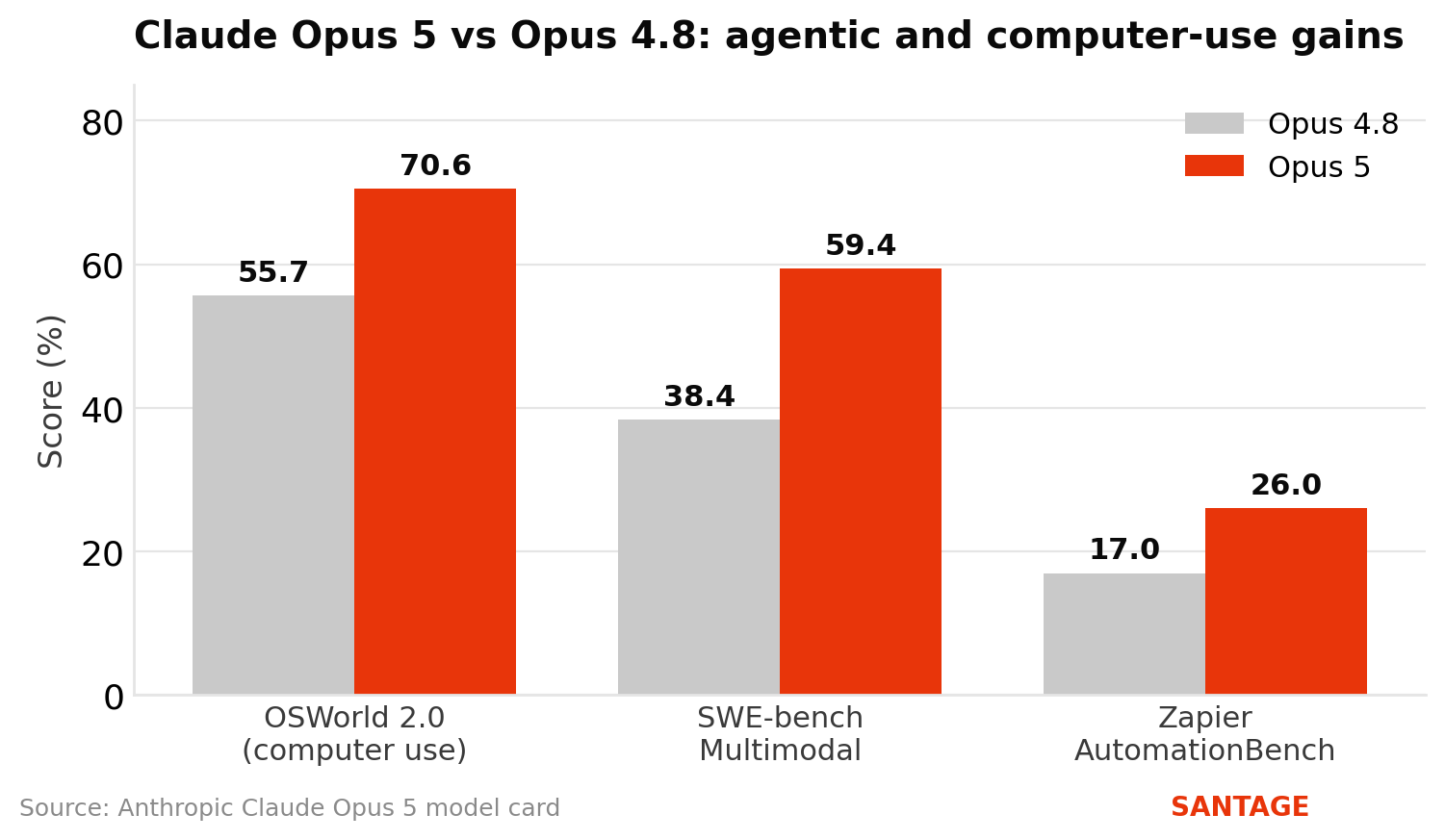
The benchmark scores put that pricing in context. Opus 5 reached 96.0% on SWE-bench Verified and 79.2% on the harder SWE-bench Pro. The clearest jumps came in agentic and computer-use work, where the model moved well ahead of the version it replaces.
Extended thinking is on by default. A per request effort setting of low, medium, or high lets a developer raise reasoning compute for difficult problems or lower it to cut latency and cost on simpler calls, a control that matters most for agents running thousands of steps.
Why a cheaper near-frontier model shifts agent economics
| Input / output price | $5 / $25 per million tokens, unchanged from prior Opus |
| Context window | 1 million tokens, default and maximum |
| Price vs Claude Fable 5 | Roughly 50% lower input cost |
| SWE-bench Verified | 96.0% |
The competitive axis for coding agents is no longer the single highest benchmark score. It is the cost of a completed task across a long chain of tool calls. By pricing a near-frontier model at half the input cost of its own flagship, Anthropic is undercutting the per-token math that governs whether a company runs an agent on the top model or settles for a weaker one.
Opus 5 moves the price of good enough close to the price of routine, and that is the number enterprise buyers actually optimize.
That pressure lands hardest on rivals selling frontier capability at frontier prices. When a model that resolves 96% of verified software issues costs the same as last year's Opus, the premium tier has to justify itself on the margin of tasks that only the very best model can finish. Opus 5 does not claim the top of every leaderboard, and it does not need to. It changes what a company should expect to pay for near-frontier work, and that reset is what competitors now have to answer.
Santage is committed to independent, transparent journalism. This article is produced in accordance with Santage's Editorial Standards and aims to provide accurate and timely information. Readers are encouraged to verify information independently.