
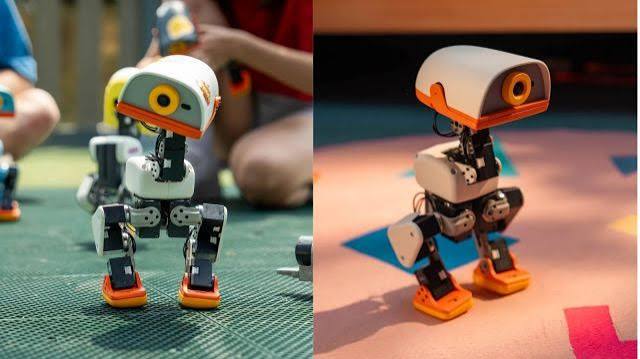
- Hugging Face's Pollen Robotics unit opened pre-orders on August 27 for Microduck, a 25-centimeter open-source bipedal robot priced at $399 and shipping before Christmas 2026. The software stack is released under Apache-2.0.
- Microduck does not run scripted animations. Its walking, kicking, roller-skating, and self-recovery behaviors are trained in simulation with reinforcement learning, roughly one to two hours across 4,096 parallel virtual robots, then exported to run on the physical duck at 50 hertz.
- The launch pushes Hugging Face's open-source playbook from software into hardware. For the price of a mid-range phone, a developer gets a legged robot plus the full training pipeline, the part almost every other robotics company keeps closed.
A legged robot for the price of a phone
Pollen Robotics, the French hardware team Hugging Face bought in April 2025, has put a walking robot on sale for $399. Microduck stands 25 centimeters tall, weighs under 800 grams, and carries 15 motors across its legs, neck, head, and an articulated beak it uses to pick up small objects. Pre-orders opened on August 27, 2026, with delivery targeted before Christmas.
The hardware is deliberately ordinary. A Rockchip RK3566 with a small AI accelerator, 1 gigabyte of memory, and 32 gigabytes of storage handle onboard compute. Sensing comes from a front camera, an 8-by-8 time-of-flight lidar matrix, two inertial measurement units, microphones, and a speaker. A removable camcorder battery gives about an hour of runtime. None of these are frontier components. That is the point. The value is not in the parts, it is in what the robot teaches itself to do with them.
| $399 | pre-order price, shipping before Christmas 2026 |
| 25 cm | height, under 800 g weight, 15 motors |
| Sensing | 8x8 time-of-flight lidar, two IMUs, front camera, microphone and speaker |
| Compute | Rockchip RK3566, 1 GB RAM, 32 GB storage, about 1 hour of battery |
| 13 tasks | training registry covering walking, kicking, standing up, and roller-skating |
| Apache-2.0 | software license, with training and runtime code on GitHub |
How the duck learns
Microduck's most important feature is invisible on the spec sheet. Its behaviors are not hand-coded. Pollen Robotics trains each policy in a physics simulator using reinforcement learning, then transfers the result to the real robot, a method the field calls sim-to-real. The training run happens across thousands of simulated ducks at once, with deliberate noise added so the policy survives the messiness of the physical world.
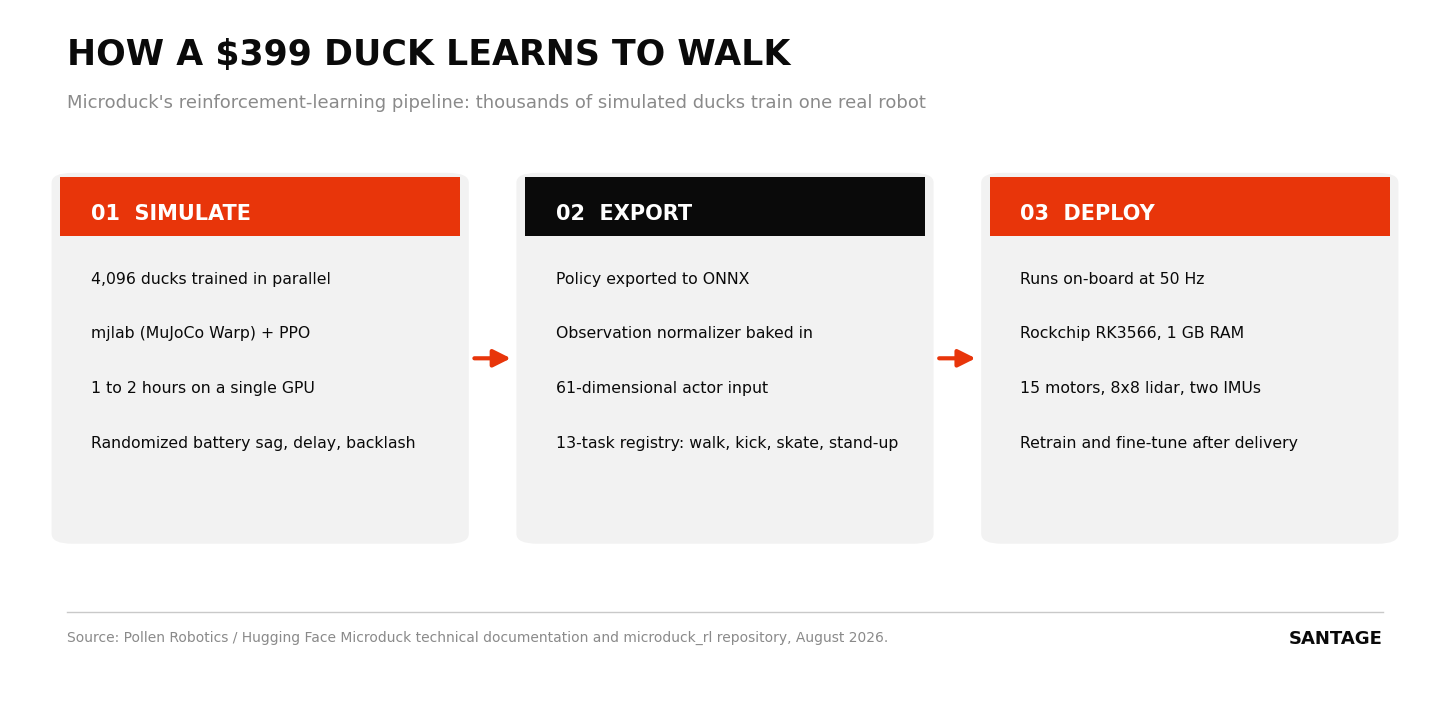
The specifics matter because they are all public. Training uses mjlab, a MuJoCo Warp environment, with the PPO algorithm and 4,096 parallel environments, completing in one to two hours on a single CUDA GPU. To close the reality gap, the team models each actuator's voltage, back-EMF, and friction, then randomizes battery sag, command delay, and up to one degree of joint backlash. The finished policy exports to ONNX, with the observation normalizer baked into the graph, and runs at 50 hertz on the duck itself. A developer can retrain or fine-tune any of the 13 registered tasks after the robot arrives.
Welcome to the era of open-source affordable robots to democratize physical AI and world models! Microduck is an open-source robot you can teach new tricks with reinforcement learning.Clement Delangue, Hugging Face CEO, on X, August 27, 2026
Pollen Robotics demonstrates Microduck walking, recovering from falls, and roller-skating. Source: Pollen Robotics on YouTube.
Why an open training stack changes the game
Robotics companies have shipped hobbyist robots before. What almost none of them ship is the method. Boston Dynamics does not hand you the code that makes Spot walk. Unitree sells capable quadrupeds but keeps the learning pipeline proprietary. Microduck inverts that. The behaviors are the demo, but the training repository is the product, and it is released under a permissive license that lets anyone copy, modify, and commercialize it.
Welcome to the era of open-source affordable robots to democratize physical AI and world models! Microduck is an open-source robot you can teach new tricks with reinforcement learning.
— clem 🤗 (@ClementDelangue) August 27, 2026
That is the same wedge Hugging Face used to become the center of open-source software AI. It did not build the best model. It built the place where everyone else's models lived, learned, and improved. Applying that logic to physical AI means the company is betting that the next wave of robotics talent will train on cheap, open, hackable hardware rather than six-figure research platforms locked behind licenses.
| Attribute | Reachy Mini | Microduck |
|---|---|---|
| Form | Desktop, stationary | Bipedal, mobile |
| Launch price | $499 (Lite $399) | $399 |
| Locomotion | None | RL-trained walking, skating |
| Training stack | Open | Open (Apache-2.0) |
| Released | July 2025 | Pre-orders August 2026 |
Source: Pollen Robotics and Hugging Face product pages, 2025 to 2026.
The behaviors are the demo. The training repository is the product. That is the part every other robotics company keeps locked.
What is not open, and why it matters
The openness has a boundary. Pollen Robotics released the software, the simulation, and the RL training stack, but the mechanical and electronic design files are not open-source. You can teach the duck anything, but you cannot yet freely manufacture your own. That keeps hardware margin with Hugging Face while the community does the expensive work of expanding the robot's skills, a split that looks familiar from open-core software businesses.
The wager underneath a cute duck is serious. If physical AI follows the path software AI took, the platform that trains the most robots, not the one that builds the most expensive one, ends up owning the category. Hugging Face has run this play before. Microduck is it, on legs.
Santage is committed to independent, transparent journalism. This article is produced in accordance with Santage's Editorial Standards and aims to provide accurate and timely information. Specifications are drawn from Pollen Robotics and Hugging Face documentation at launch and may change before shipping. Readers are encouraged to verify information independently.