
Image: Hugging Face
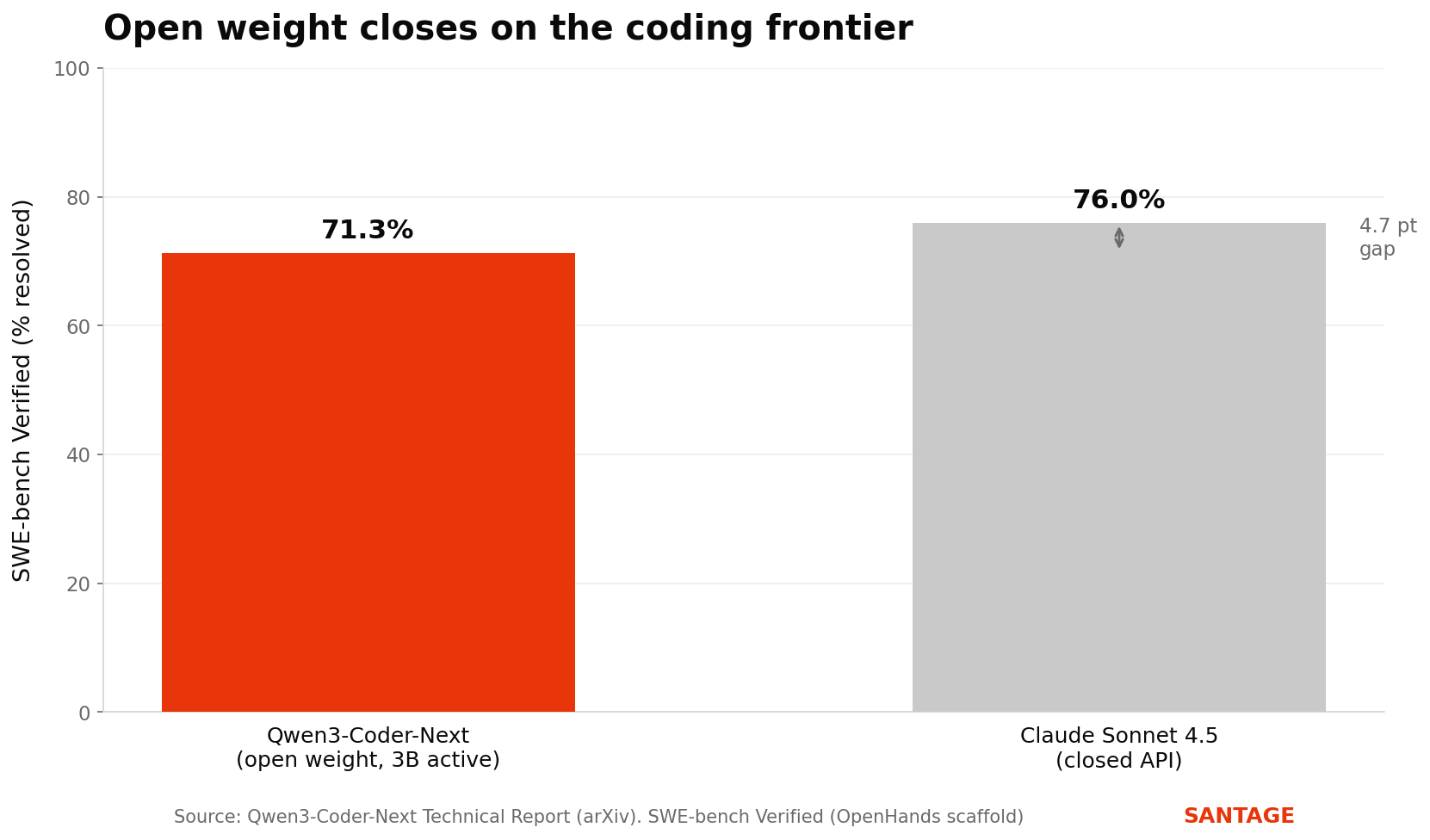
- Qwen3-Coder-Next scores 71.3 percent on SWE-bench Verified, against 76.0 percent for Claude Sonnet 4.5, a gap of under five points.
- It reaches that level with 80 billion total parameters but only 3 billion active per token, roughly an order of magnitude less active compute than the closed models it trails.
- Because the weights are open and self-hostable, the remaining gap is now a cost and control decision for engineering teams, not a capability wall.
Qwen3-Coder-Next lands within five points of Claude on SWE-bench
For two years the honest answer to "can an open model replace Claude for real coding work" was no. The open releases were fine for autocomplete and boilerplate, and they fell apart on the multi-step, repository-scale tasks where Anthropic's models earned their reputation. That answer is now dated. Alibaba's Qwen3-Coder-Next resolves 71.3 percent of SWE-bench Verified issues under the OpenHands scaffold and 70.6 percent under SWE-Agent, according to its technical report. Claude Sonnet 4.5, the reference point the report itself uses, sits at 76.0 percent on the same benchmark.
A gap of under five points on the industry's hardest agentic-coding test is not parity, but it is close enough to change the conversation. The chatter across developer forums this month is not about whether Qwen can match Claude on a leaderboard. It is about engineers running the open model on their own hardware and reporting that it clears most of the pull requests they would previously have sent to a paid API.
| Model | SWE-bench Verified | Active params | Context | Weights |
|---|---|---|---|---|
| Qwen3-Coder-Next | 71.3% | 3B (of 80B) | 262,144 tokens | Open |
| Claude Sonnet 4.5 | 76.0% | Undisclosed | Undisclosed | Closed |
Why a 3-billion-active-parameter model rewrites the coding cost equation
The number that matters most is not the benchmark score. It is the 3 billion active parameters. Qwen3-Coder-Next is a mixture-of-experts model with 80 billion total weights that fires only 3 billion of them on any given token. It reaches within striking distance of the frontier while using, by the report's own description, an order of magnitude less active compute than several models it matches or beats. That combination is what makes self-hosting realistic rather than aspirational.
Cheap active compute plus open weights removes the two frictions that kept teams on closed APIs: per-token cost that scales with usage, and the inability to run the model inside their own security perimeter. A model that activates 3 billion parameters can serve on hardware a mid-size engineering team already owns, at a marginal cost per task that rounds to electricity.
The moat was never the benchmark, it was the workflow
Here is the part most benchmark coverage misses. Qwen's own researchers do not credit raw scale for the jump. They credit training method.
Scaling agentic training, rather than model size alone, is a key driver for advancing real-world coding agent capability.
Qwen3-Coder-Next Technical Report, arXiv
That sentence is a warning to every lab whose coding advantage rests on model size. If the durable edge comes from training a model to plan, call tools, run tests, and recover from its own errors across a long task, then that edge is a process, and processes get copied faster than they get protected. Anthropic's genuine strength in coding was never a single benchmark number. It was the surrounding system: the harness, the tool discipline, the reliability across a hundred-step task where a smaller model quietly derails. The open ecosystem is now attacking exactly that layer.
What engineering leaders actually decide now
For a team choosing an AI coding stack in the second half of 2026, the decision has inverted. The old default was a closed API, with self-hosting reserved for firms with hard data-residency rules. The new question is why not self-host, given that an open model clears most tasks at a fraction of the running cost and never sends a line of proprietary code to a third party. Claude keeps a real edge on the hardest tail of problems, the multi-repository refactors and the ambiguous, underspecified tickets where those last five points live. For many teams that tail is where the value is, and paying for it is rational. For many others it is not.
The strategic risk for Anthropic and its closed peers is not that they lose the benchmark. It is that the benchmark stops being the thing customers buy. When the open option is five points behind, free to run, and private by default, the premium model has to justify its price on reliability and support rather than capability alone. That is a harder sale, and it is the sale the entire closed-frontier business now has to make.
Qwen did not beat Claude this month. It did something more corrosive to the closed-model thesis: it made the gap small enough that most of the market can afford to ignore it.
Santage is committed to independent, transparent journalism. This article is produced in accordance with Santage's Editorial Standards and aims to provide accurate and timely information. Readers are encouraged to verify information independently.