

- On August 4, Cloudflare announced Cloudflare Wallets and cloudflare.pay, giving AI agents a stablecoin wallet and a stable identity so they can pay for APIs, content, and tools on their own using the x402 protocol.
- The system splits into Account Wallets for the humans who own Cloudflare accounts and Virtual Wallets for their agents, with the account owner setting guardrails such as an allowance, an allow list, and a maximum transaction size.
- Handle reservation opened the same day at cloudflare.pay. Onramping, offramping, and full agent spending are due in the coming months.
Agents get a wallet and a name
Cloudflare said on August 4 that it is building payment and identity tools aimed squarely at software that acts on its own. The launch, part of the company's Agents Week, lets an AI agent hold stablecoins, buy services across the web, and identify itself to the merchants it transacts with. The plumbing is the x402 protocol, an open standard that attaches a payment to an HTTP request so a machine can pay for an API call the way a browser loads a page.
The move pairs with the Monetization Gateway that Cloudflare announced earlier in the month, which lets its customers sell content and APIs to agentic buyers. Selling to agents only works if agents can pay, and traditional card rails were built for humans clicking checkout buttons, not for a research agent evaluating dozens of tools in a loop. Wallets is Cloudflare's answer to the buy side of that market.
"You will be able to define guardrails for your Virtual Wallets (such as an allowance, an allow list, and a maximum transaction size) to help your agent spend money safely from your account."Cloudflare, in its August 4 product announcement, via the Cloudflare Blog
Two wallets, one set of limits
The design separates the human from the machine. An Account Wallet belongs to the person who owns the Cloudflare account, who can add funds, delegate spending to agents, and pull money back. A Virtual Wallet belongs to an agent and operates through API keys, spending only within the permissions the account owner grants and never above the cap the owner sets.
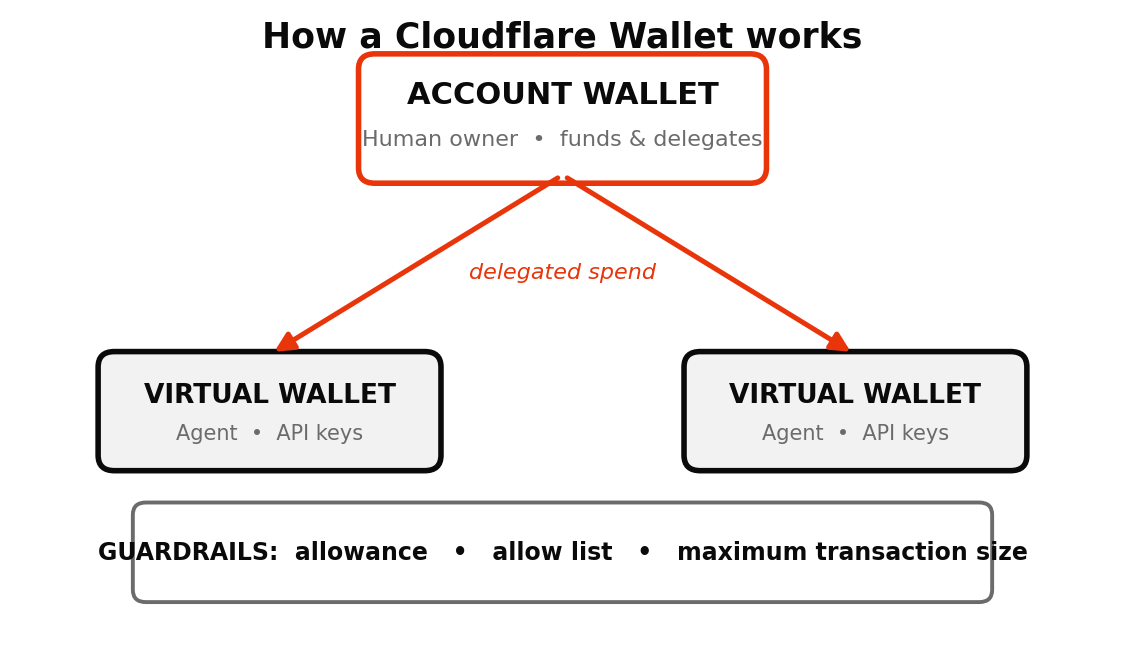
The point of the caps is to let an agent explore without a human approving every step. Cloudflare frames the limits as freedom rather than restriction: an agent responsible for ten dollars can be left to test many APIs on its own, because the downside is bounded. When spending looks anomalous, an authorized human can review it and either raise the limit or confirm the cap did its job.
| Handle reservation opens at cloudflare.pay | August 4 |
| Wallet tiers, Account for humans and Virtual for agents | 2 |
| x402 payments processed in the protocol's first year | 169 million |
An identity layer for the agentic web
The second half of the announcement is identity. Through cloudflare.pay, an agent can optionally attach a human-readable handle to its wallet, so a research agent might present itself as research.example.cloudflare.pay and let a merchant know which organization it works for. Cloudflare compares the approach to the way DNS maps a memorable name to a hard-to-read address, and says it will adopt richer identity schemas as the x402 Foundation develops them.
For now the product is a reservation and a promise. Handles are claimable today, while funding, spending, and the machine-native marketplace Cloudflare describes are still to come. With most web traffic now driven by bots, the company is betting that agents will need first-class ways to pay and to be recognized, and it wants its rails in place before that traffic starts spending.
Santage is committed to independent, transparent journalism. This article is produced in accordance with Santage's Editorial Standards and aims to provide accurate and timely information. Readers are encouraged to verify information independently.