
- SpaceXAI released Grok 4.6, which scores 61 on the Artificial Analysis Intelligence Index, up from 56 for Grok 4.5 and level with GPT-5.6 Sol Max.
- The model ships a 500,000-token context window and priced entry-tier inference at $2 per million input tokens and $6 per million output, holding the line on cost while raising capability.
- SpaceXAI says Grok 4.6 is a post-training upgrade rather than a larger base model, a signal that this round of gains came from reinforcement learning, not more parameters.
Grok 4.6 ties GPT-5.6 Sol Max on the intelligence index
SpaceXAI released Grok 4.6, its new flagship, tuned for long-running agents, coding, and multi-step tool use. On the Artificial Analysis Intelligence Index, an aggregate of reasoning, coding, and knowledge benchmarks, Grok 4.6 scores 61, drawing level with GPT-5.6 Sol Max and up five points from Grok 4.5. It reaches that mark with a 500,000-token context window and entry pricing held at $2 per million input tokens and $6 per million output, the same tier as the model it replaces.
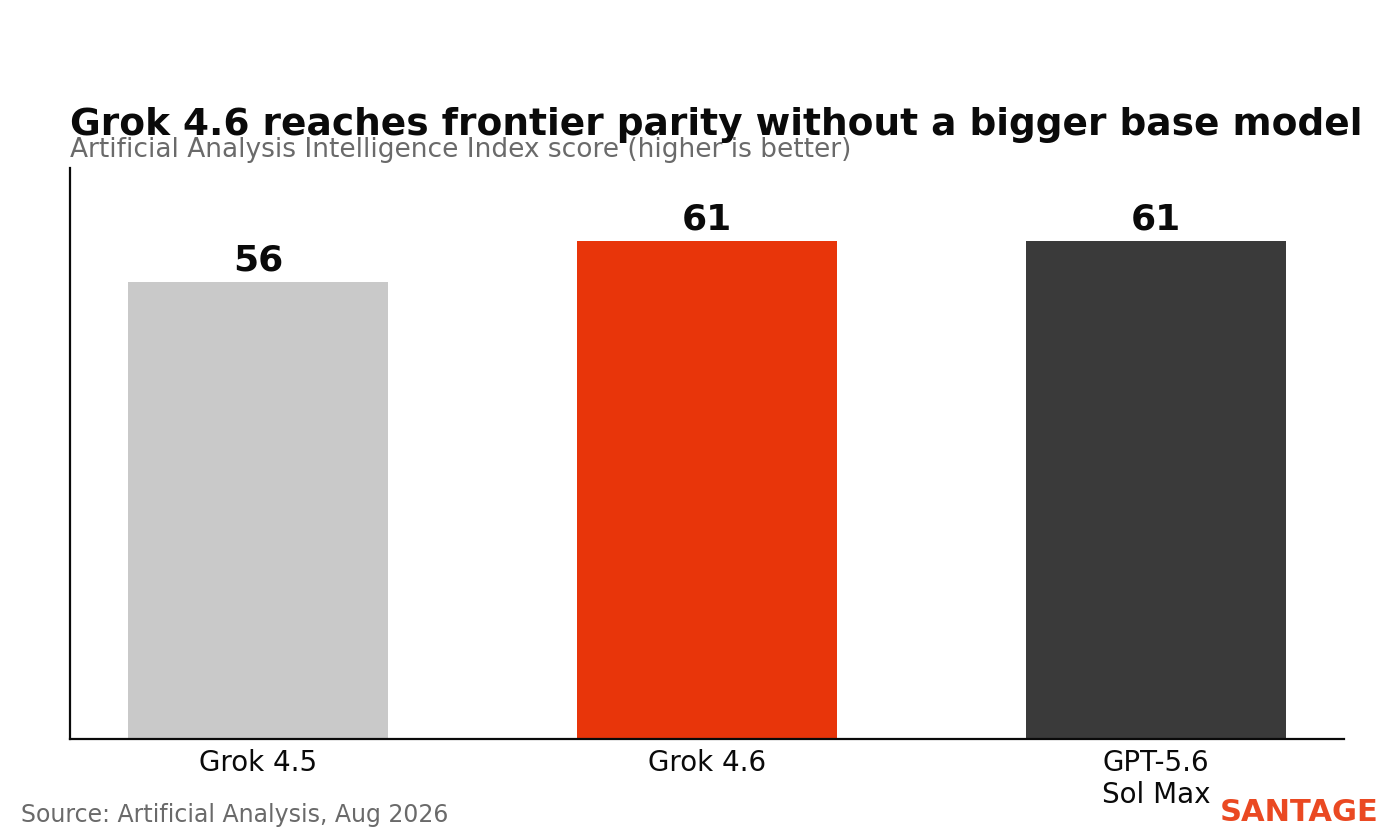
The benchmark detail is more mixed than the headline parity suggests. Grok 4.6 leads on some agentic tests and trails on others, notably in autonomous software engineering.
| Benchmark | Grok 4.6 | Reference |
|---|---|---|
| Artificial Analysis Intelligence Index | 61 | GPT-5.6 Sol Max: 61 |
| DeepSWE v1.1 (autonomous coding) | 65.9% | GPT-5.6 Sol Max: 73% |
| CursorBench v3.2 | 69.9% | Up from Grok 4.5 |
| Context window | 500K tokens | Entry price: $2 in / $6 out |
Grok 4.6 selected benchmarks and pricing. Source: Artificial Analysis and SpaceXAI, August 2026.
A post-training upgrade, not a bigger base model
The most telling line in the release is what Grok 4.6 is not. SpaceXAI describes it as a post-training upgrade built on extended supplemental training and improved reinforcement learning, not a larger base model. The parity with GPT-5.6 Sol Max was bought with better training on the same foundation, not more parameters.
That matters beyond xAI. If a five-point jump to frontier parity can come from post-training alone, the industry's assumption that each capability tier requires a bigger, costlier base model weakens. It also explains why the price did not move. A post-training upgrade does not enlarge the model you have to serve, so SpaceXAI can raise capability without raising the inference bill, and hold entry pricing at $2 and $6 while a heavier variant sits above it.
Grok 4.6 does not claim the top of the leaderboard, and it still trails the best on hard coding tasks. What it demonstrates is that the distance between a fast follower and the frontier is now measured in training runs rather than in orders of magnitude of compute, and that gap is closing from below faster than the leaders can pull away.
Santage is committed to independent, transparent journalism. This article is produced in accordance with Santage's Editorial Standards and aims to provide accurate and timely information. Readers are encouraged to verify information independently.