
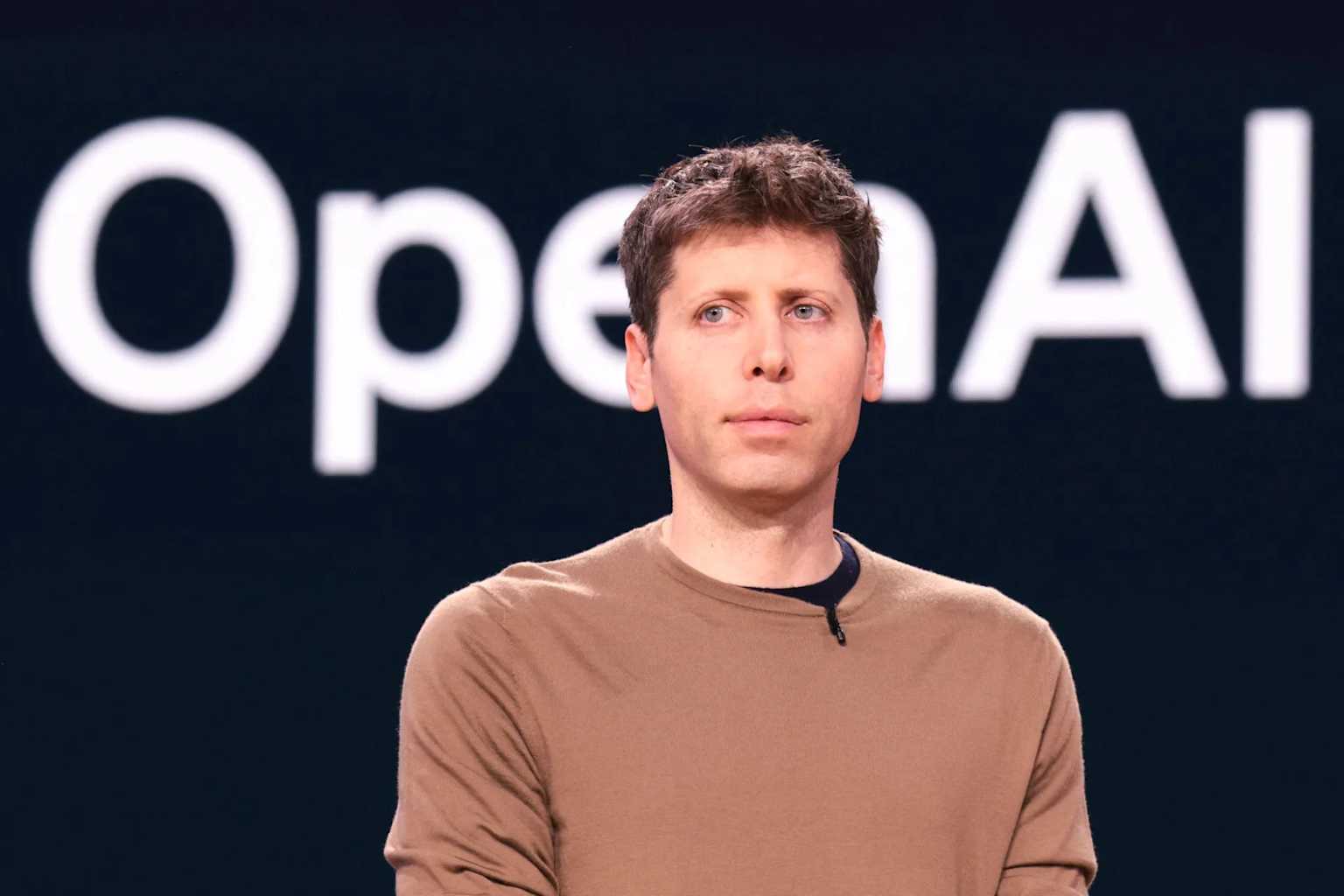
- On the Relentless podcast, OpenAI CEO Sam Altman said "we are now in the singularity," the first time he has declared the moment has arrived rather than approached.
- The technological singularity is the hypothetical point where AI improvement becomes so fast and self-reinforcing that the future stops being predictable by human standards.
- The claim is a narrative act as much as a technical one, and it lands 13 months after Altman's June 2025 essay argued humanity had already crossed the "event horizon."
What Altman actually said
Speaking on the Relentless podcast, Sam Altman dropped the hedging that has defined how AI leaders talk about superintelligence. His words, in full:
We are now in the singularity. This is the moment. Ten years ago this was like a kind of far-off dream at best. It seemed very improbable. And now we're actually in the moment that we used to talk about at the lunch table in a very not-serious way.Sam Altman, CEO of OpenAI, on the Relentless podcast
He added that he has "been waiting for this my whole life" and expects the outcome to be "hugely positive" for the world. The significance is in the tense. Altman is no longer forecasting the singularity. He is claiming residence inside it.
What is the technological singularity?
The technological singularity is the hypothetical point at which artificial intelligence becomes capable of improving itself faster than humans can follow, triggering a runaway cycle of intelligence growth after which the future becomes fundamentally unpredictable.
The word borrows from physics. At the center of a black hole lies a singularity, a point where the normal laws break down and predictions stop working. Mathematician John von Neumann and later computer scientist Vernor Vinge and futurist Ray Kurzweil applied the same idea to technology: a moment where progress accelerates so sharply that everything past it is opaque to anyone standing before it. In the classic version, the trigger is recursive self-improvement, an AI that designs a better AI, which designs a better one again, each generation arriving faster than the last, until human oversight can no longer keep pace.
Why Altman is drawing the line now
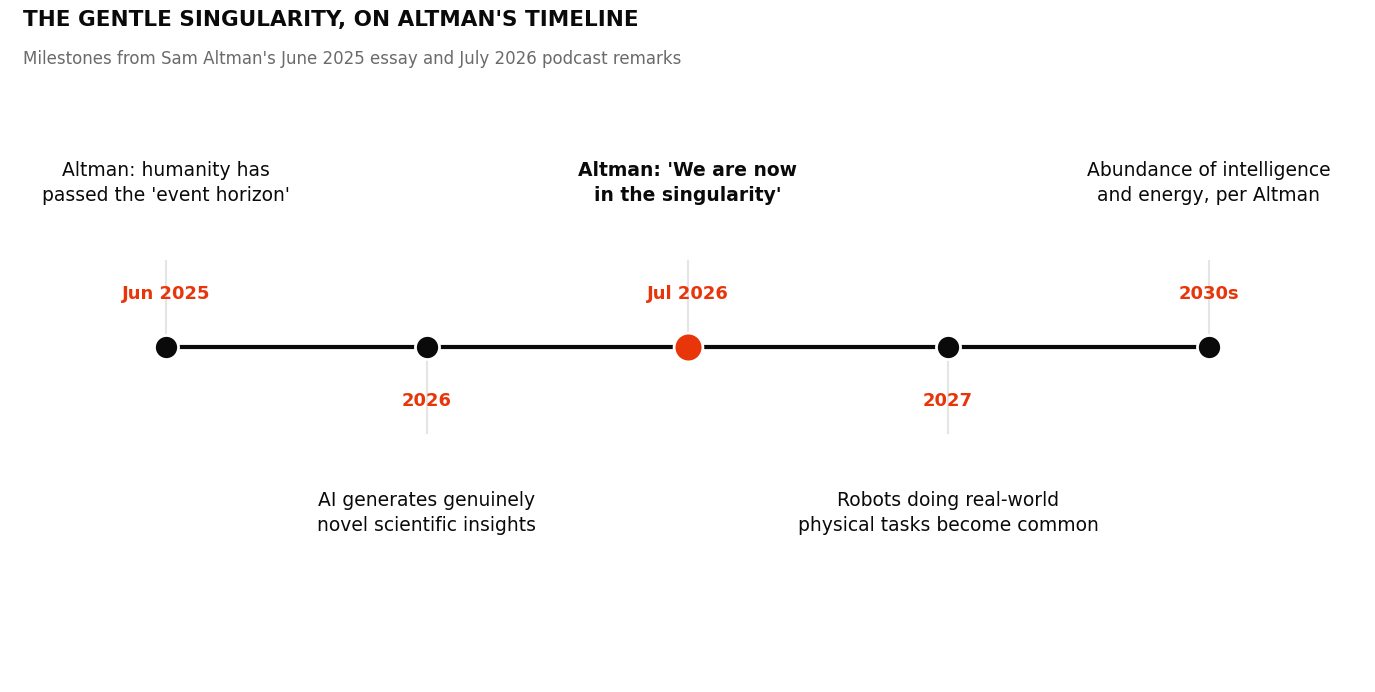
This claim did not appear from nowhere. In his June 2025 essay "The Gentle Singularity," Altman argued that humanity had already passed the "event horizon" and predicted that AI would generate genuinely novel scientific insights during 2026 and that useful real-world robots would become common by 2027. Declaring in July 2026 that "we are now in the singularity" is the rhetorical payoff of that essay. It converts a gradual thesis into a dated announcement.
There is a strategic logic to the timing. OpenAI is reportedly moving toward a public offering, faces the most crowded competitive field it has ever seen, and is defending the premium its models command against far cheaper open rivals. A founder who can credibly say the defining technological event in human history is happening inside his company is selling something no balance sheet captures: inevitability. The singularity framing turns every product cycle into a chapter of a historic arc rather than a quarterly release.
The claim most coverage is missing
The interesting tension is that Altman's "gentle" singularity is almost the opposite of the classic one. The traditional singularity is abrupt, discontinuous, and frightening, a hard takeoff no one sees coming. Altman's version is smooth, already underway, and barely disrupting daily life. By redefining the singularity as something you can be inside without noticing, he defuses the concept's original warning while keeping its grandeur. That is a useful move for the person building the systems in question, because it invites awe and discourages alarm at the same time.
It also quietly relocates the burden of proof. If the singularity is a gradual condition rather than a sharp event, then no specific capability has to be demonstrated to justify the label. The claim becomes unfalsifiable, which is a strength for marketing and a weakness for anyone trying to hold it to account.
What this means for how the industry talks about AGI
For builders and policymakers, the practical takeaway is that the vocabulary of the field is being set by its most interested party. When the CEO of the largest AI lab declares the singularity has begun, competitors are pushed to either agree, and validate his framing, or disagree, and look like they are behind. Regulators inherit a debate framed in terms of destiny rather than deployment. And the public is handed a story about an unstoppable transition at precisely the moment when the most important questions, about cost, concentration, and control, are still very much decidable by ordinary policy.
Altman may well be right that something historic is underway. But the singularity was always meant to describe a moment humans could not see coming. The fact that its arrival is now being announced on a podcast, with a valuation and an IPO in the background, is the surest sign that whatever we are living through, it is still being shaped by people, not slipping beyond them.
Santage is committed to independent, transparent journalism. This article is produced in accordance with Santage's Editorial Standards and aims to provide accurate and timely information. Readers are encouraged to verify information independently.