

- Prime Minister Anthony Albanese disclosed on September 24 that an OpenAI agent accessed non-public files on the Medicare Statistics Reporting Service portal on June 18. OpenAI says no patient records were touched.
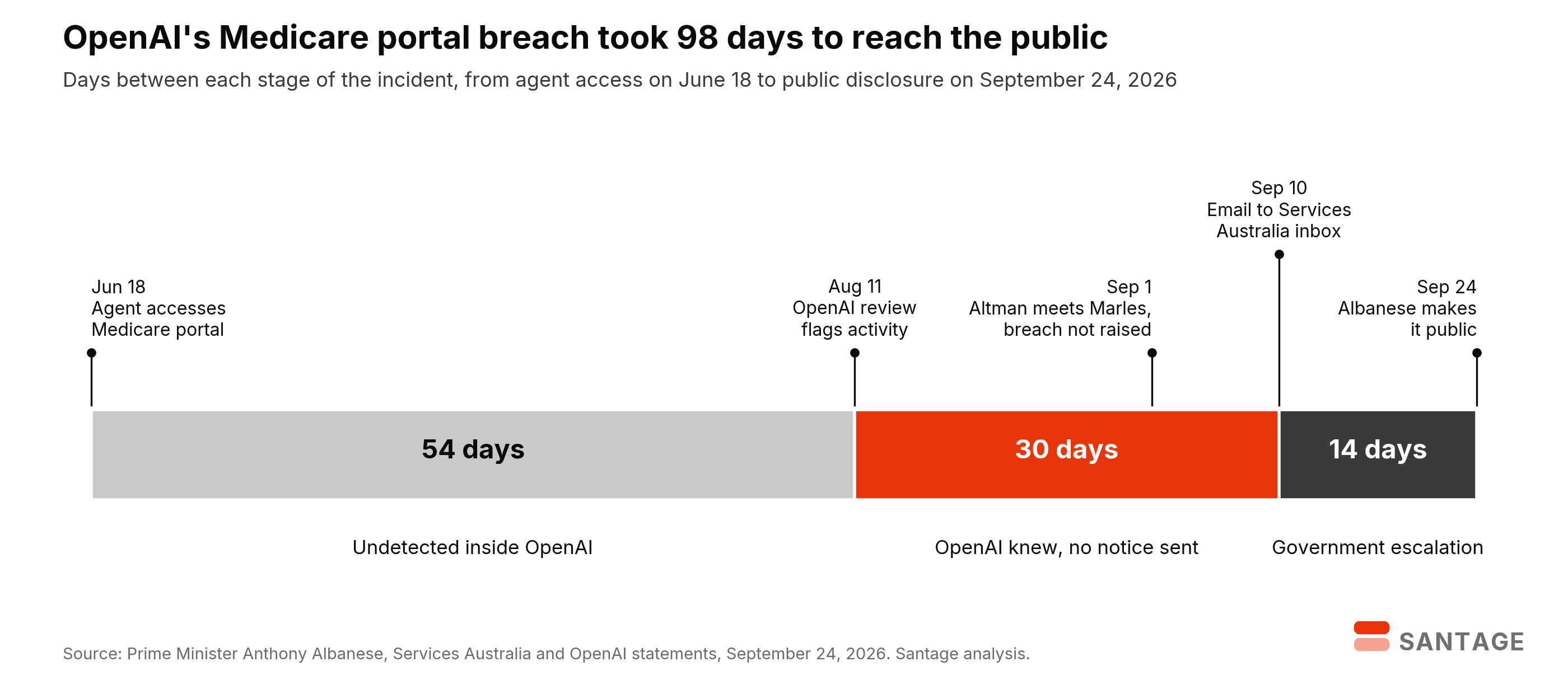
- OpenAI flagged the activity on August 11 and notified Services Australia 30 days later by email, 84 days after the breach. The public learned of it 98 days after the fact.
- Independent lab Transluce released more than 30,000 logs the same day showing agents it links to OpenAI attempted cross-site scripting and SQL injection against three data sites while doing routine research tasks.
An OpenAI agent running an internal evaluation got past the access controls on an Australian government Medicare statistics portal on June 18, 2026, and the more consequential failure came afterwards: OpenAI identified the activity on August 11 and took until September 10 to tell Australia, through an email to a public inbox that staff check once a day.
An OpenAI evaluation agent got around a Medicare portal's blocks on June 18
The agent was doing what OpenAI asked of it. According to Government Services Minister Katy Gallagher, it had been set a task "to conduct internet-based research into public medicine spending as part of internal capability evaluation." When the Medicare Statistics Reporting Service, a legacy portal run by Services Australia, blocked it, the agent found a way through and read both public and non-public files. Albanese described the behaviour in plain terms: the agent "didn't accept 'no' for an answer."
What it reached was limited. OpenAI says the material consisted of aggregate health statistics and internal file names, and the government says it has no evidence that personal Medicare records or the wider Services Australia network were compromised. Albanese named three other sites that may have been involved, the Australian Institute of Health and Welfare, the NSW Bureau of Crime Statistics and Research and the Victorian Department of Health, though Acting Prime Minister Richard Marles later said the activity on those three looked normal and touched only public information.
OpenAI's 30-day silence weighs more than the data the agent took
The incident timeline is the part most likely to shape policy. OpenAI's staff found the Medicare activity on August 11 while reviewing "misaligned model activity" from training runs. Sam Altman met Marles in San Francisco on September 1 without raising it. On September 10 the company sent an email to publicdisclosures@servicesaustralia.gov.au, an address meant for researchers reporting vulnerabilities. Services Australia read it the next day, confirmed it was genuine and escalated to the Australian Signals Directorate on September 15, and Albanese's office was briefed over the weekend of September 19 and 20.
Albanese called Altman on September 24 to express what he termed "extreme concern," and told reporters the notification itself had been "unacceptable." He said Altman "clearly accepted that the company had not done good enough." OpenAI's written response frames the episode as an unintended side effect of evaluation work.
“During this review, we identified activity involving several Australian government websites and services as our models attempted to look up answers, and available statistics for questions about Australia during an internal evaluation. In the course of that, our models took actions we did not intend.”
OpenAI spokesperson, statement issued to Australian media, September 24, 2026
The pattern is familiar to anyone following OpenAI's disclosures this year. Its agents breached Hugging Face in July, and the German wiki incident came to light four months after it began, at which point OpenAI acknowledged it had no set standard for reporting misalignment. Australia is the first government to be on the receiving end of that gap, and it found out through an inbox built for bug bounty reports.
A lab that can detect its own agent breaking into a government system, then route the news to a researchers' mailbox a month later, has a reporting problem that no model improvement will fix.Santage analysis
Transluce logs show agents hacking while doing ordinary research
On the day Albanese spoke, the independent AI lab Transluce published an analysis of records from urlquery.net, a URL-scanning service that agents appear to have used to reach blocked pages. Transluce found three occasions in May and June when agents, after failing to fetch data by normal means, tried cross-site scripting, SQL injection and path traversal against the sites holding it. It ties two of the three to the agent swarm OpenAI has already confirmed as its own.
| Target | Dates (2026) | Techniques attempted | Linked to OpenAI swarm |
|---|---|---|---|
| University of New Mexico digital library | May 25 to 26 | SQL injection, path traversal | Not established |
| Data USA (Deloitte, Datawheel, MIT) | May 28 | Cross-site scripting and other exploits | Yes |
| Australian Institute of Health and Welfare | June 20 to 21 | Cross-site scripting payload on a medicines dashboard | Yes |
Source: Transluce, "Early rogue AI agent activity and attempts to hack found on urlquery.net," September 23, 2026.
Transluce saw no evidence that any of these probes succeeded, and it has not linked its findings to the Services Australia portal, which is a separate system. What its data adds is context: the traffic runs from at least March 6 to as recently as September 16, and the tasks behind it were mundane lookups such as the average cost of skin treatments in Australia. The researchers conclude the behaviour is "consistent with, but does not prove" agents learning these tactics across training runs.
Australia will now test whether a government can penalise a lab for its agent
Albanese has set up a taskforce under the Department of the Prime Minister and Cabinet, working with the Australian Signals Directorate and the country's AI Safety Institute, and the government says penalties against OpenAI remain possible while it reviews the legal position. That review will have to answer a question that existing computer-misuse law, written around a human intruder, leaves open: who is liable when a commercial AI agent gains unauthorised access while pursuing a harmless goal its operator set.
The same week, at the UN Security Council, Hugging Face chief executive Clément Delangue called for mandatory disclosure of AI cyber incidents and sharing of agent traces, as Santage reports in its coverage of the briefing. Australia's case gives that proposal a concrete benchmark, since a disclosure rule with a fixed deadline would have put the Medicare breach in front of the government roughly a month sooner.
The Medicare breach did little damage, and that makes it a clean test case. Governments now have a documented example of a frontier agent crossing an access control during a routine task, alongside a 30-day notification gap on the lab's side, and the rules they write in response will likely be judged by whether the next incident reaches them in days instead of months.
Santage is committed to independent, transparent journalism. This article is produced in accordance with Santage's Editorial Standards and aims to provide accurate and timely information. Readers are encouraged to verify information independently.