
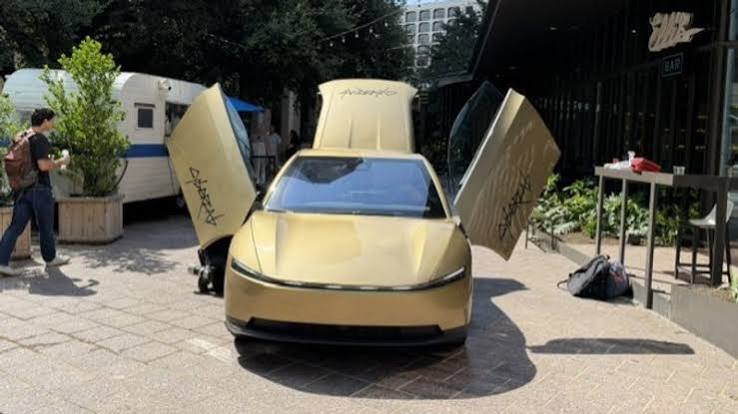
- Tesla began public Cybercab rides in Austin on September 5, a two-seat vehicle with no steering wheel or pedals, booked through the Tesla Robotaxi app.
- The service starts from just 45 Cybercabs registered in Texas, a small pilot against Tesla's plan to build up to 125,000 of the vehicles a year.
- The National Highway Traffic Safety Administration is reviewing the rollout because the car has no manual controls a person could use to take over.
A robotaxi built with no way for a human to drive
Tesla began offering public rides in the Cybercab on September 5, following an invitation-only launch event earlier in the week. The vehicle is the first Tesla designed from the ground up for autonomy, a two-seat car with gull-wing doors, a single large touchscreen, and no steering wheel or pedals of any kind. Riders hail one through a Tesla Robotaxi app that works much like Uber or Waymo, and the car handles the trip end to end on Tesla's Full Self-Driving system.
The launch is real but small. Tesla has 45 Cybercabs registered in Texas and roughly 420 autonomous vehicles across the state, and the Austin service runs inside a geofenced area with early talk of expanding to Houston and Dallas. That gap between a 45-car pilot and a car Tesla says it wants to build at up to 125,000 units a year frames the whole event, marking a first commercial step rather than a fleet at scale.
| 45 | Cybercabs registered in Texas at launch, from about 420 autonomous Teslas statewide |
| 2 | seats, with no steering wheel and no pedals |
| 125,000 | Cybercabs a year Tesla says its planned production capacity can reach |
| 1 | city live so far, Austin, with Houston and Dallas floated next |
Why the design is a regulatory test
The Cybercab is a bet that removing the driver's controls is a feature rather than a liability, and it puts that bet in front of regulators. The National Highway Traffic Safety Administration is reviewing the rollout precisely because the car lacks the manual controls that federal motor-vehicle standards were written to assume. A vehicle a person cannot take over is harder to certify than one with a wheel and a safety driver, and Tesla is asking the rules to bend around the hardware.
A robotaxi with 45 cars is a demo. A robotaxi with no steering wheel is a policy argument. Tesla launched both at once.
The launch pushes Tesla into direct competition with the driverless services already carrying paying passengers, and it lands as capital and attention flood the wider world-models and robotics frontier that underpins autonomy. It also sets Tesla against a field of well-funded rivals, including the robotaxi venture Travis Kalanick is building around physical AI. The question the next few months will answer is whether Tesla can grow the Austin fleet safely and quickly, or whether 45 cars in one geofenced city stays a milestone rather than a business.
Santage is committed to independent, transparent journalism. This article is produced in accordance with Santage's Editorial Standards and aims to provide accurate and timely information. Readers are encouraged to verify information independently.