
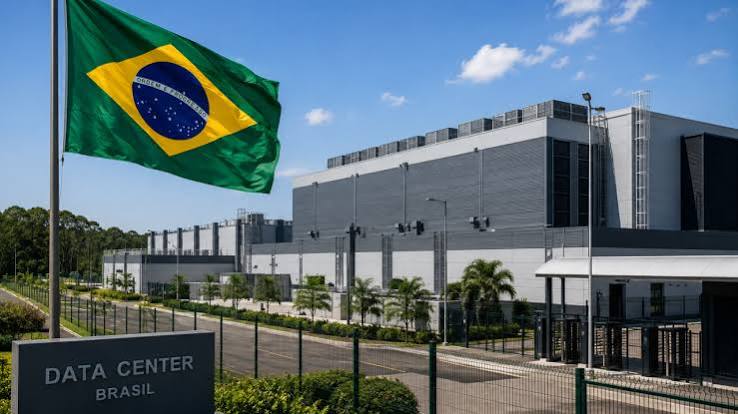
- Brazil committed $444 million (2.3 billion reais) to national AI infrastructure, funded through its National Fund for Scientific and Technological Development.
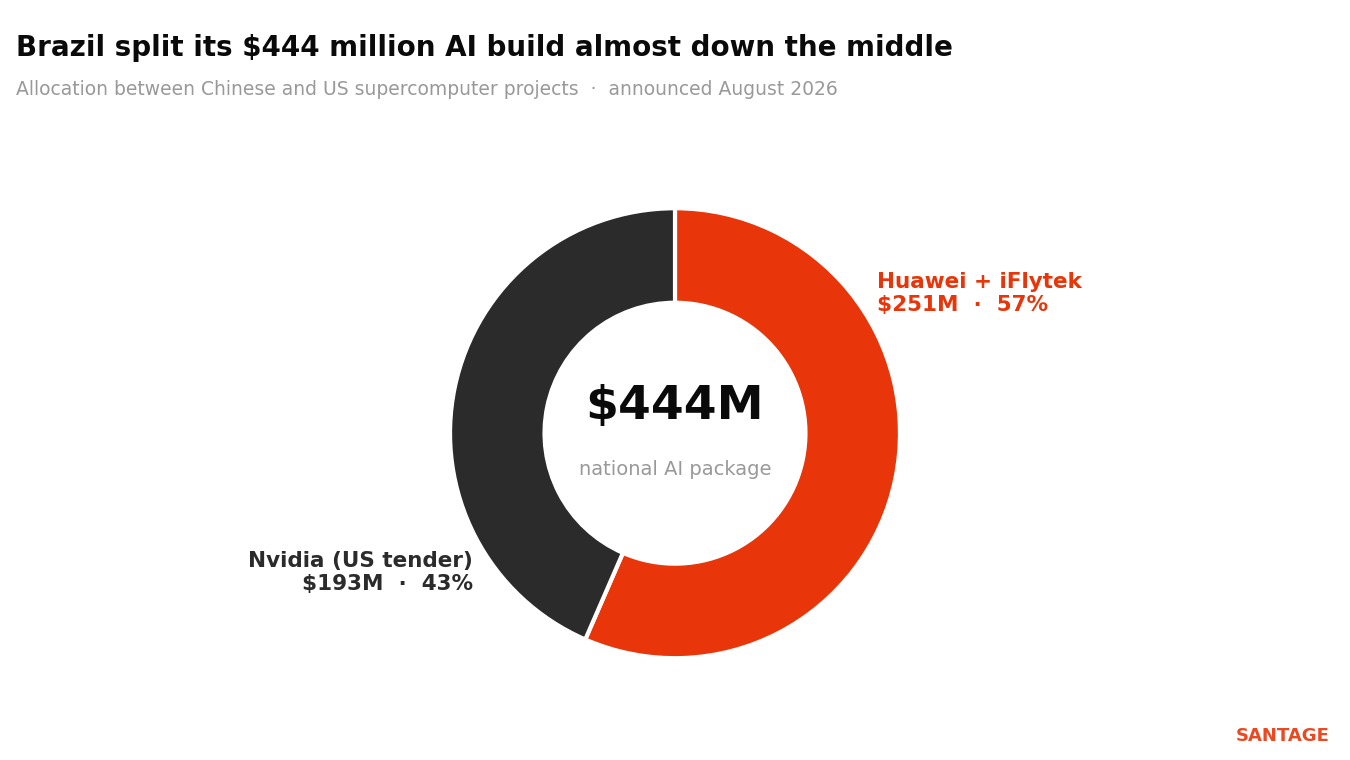
- A $251 million cluster in Rio de Janeiro goes to China's Huawei and iFlytek, while a separate $193 million tender in Rio Grande do Norte is expected to go to Nvidia-based US hardware.
- The government said the aim is "not to depend on a single company, technology or country," making the split itself the point rather than the total.
Brazil bought both stacks instead of choosing one
When a country spends on AI infrastructure, the interesting number is usually the total. Brazil's announcement inverts that. The $444 million package matters less than how it was divided: roughly $251 million for a Chinese-built supercomputer in Rio de Janeiro, developed with Huawei and the speech-AI firm iFlytek and aimed at training large language models, and roughly $193 million for a US-based system in Rio Grande do Norte, expected to run on Nvidia chips and rank among the ten most powerful AI machines in the world once live.
President Luiz Inacio Lula da Silva and Science and Technology Minister Luciana Santos framed the two-track build as deliberate, according to Reuters. The tender design was intentional: two procurements, two suppliers, two political relationships, all funded in one budget cycle before either superpower could turn the purchase into a condition.
The two systems are not interchangeable. They run on different silicon, land in different regions, and answer to different geopolitical patrons.
| Project | Rio de Janeiro cluster | Rio Grande do Norte supercomputer |
|---|---|---|
| Partners | Huawei, iFlytek (China) | US tender, Nvidia expected |
| Allocation | About $251M (57%) | About $193M (43%) |
| Focus | Training large language models | General high-performance AI compute |
| Target online | July 2027 | End of 2026 |
| Funding source | National Fund for Scientific and Technological Development | Same national fund |
Why a hedge beats a bloc for a middle power
For two years the AI infrastructure map has been drawn as a binary. Countries were expected to sit inside the American stack of Nvidia, cloud hyperscalers, and US frontier models, or inside the Chinese stack of Huawei silicon and domestic labs. Export controls, the reasoning went, would force everyone to pick a side.
Brazil is testing a third position. By seeding a Chinese supercomputer and an American one in the same budget cycle, it keeps both suppliers competing for the next contract, avoids single-vendor lock-in on hardware that will underpin a decade of national research, and preserves leverage with Washington and Beijing at once. It paired the split with a RISC-V chip partnership with Spain and a national center for algorithmic transparency, signals that the goal is optionality across the whole stack, not just the data center.
The strategy is not to depend on a single company, technology or country.Brazilian government statement on the national AI supercomputer program
The economics favor the hedge, too. A middle power that commits fully to one stack inherits that stack's export-control risk, its pricing, and its roadmap. Brazil has instead turned itself into a market both sides must keep courting, and the cost of that leverage was a single budget line rather than a decade of dependence.
The line other coverage will skip
Most reporting will file this as a China-versus-US story and score it by which supercomputer is bigger. The durable shift is that a G20 economy has priced non-alignment as a feature and paid for it in the same budget. That is a template, and middle powers with the fiscal room to run two procurements at once, think India, Indonesia, the Gulf states, now have a worked example of how to do it without waiting for either superpower's permission.
| $444M total | national commitment, split 57 percent China-built and 43 percent US-built |
| 2 supercomputers | funded in a single budget cycle, one operational by the end of 2026 |
| 1 transparency center | plus a separate RISC-V partnership with Spain, extending the hedge below the data-center layer |
What it means for the vendors
The uncomfortable read for both Nvidia and Huawei is that neither won Brazil. Each won half, and only for now. A country that can run parallel procurements has converted itself from a captured customer into a repeat buyer that plays suppliers against each other every cycle. For US policymakers who assumed export controls would quietly hand them the Global South, Brazil is the first large economy to answer that the map is not theirs to draw. The AI infrastructure race was supposed to sort the world into two camps. Brazil just showed that the most valuable position may be refusing to join either one.
Santage is committed to independent, transparent journalism. This article is produced in accordance with Santage's Editorial Standards and aims to provide accurate and timely information. Readers are encouraged to verify information independently.